
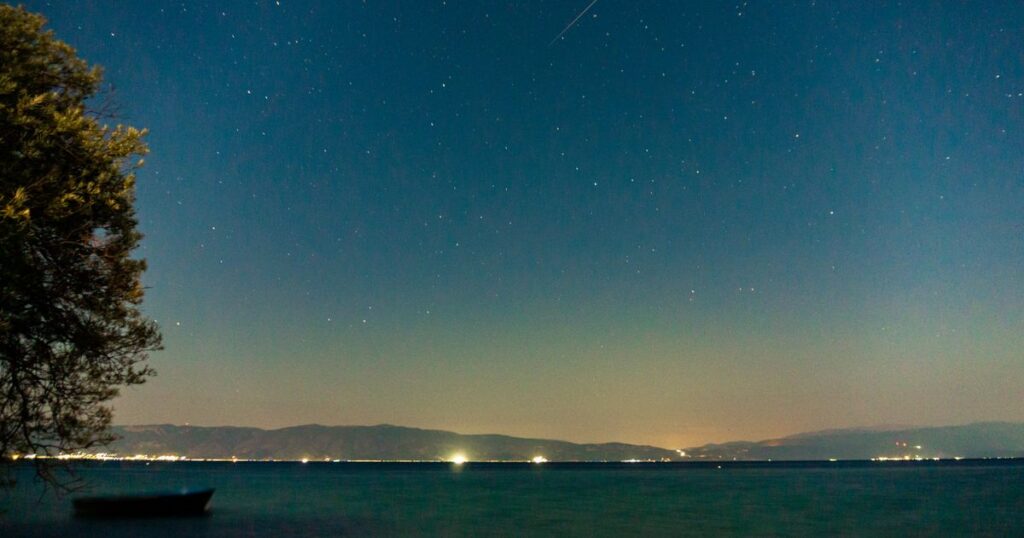
The Leonid meteor shower peaks on the night of November 17–18, 2026. It isn’t the busiest shower of the year, but its meteors are among the fastest you can see, and the Leonids are famous for producing the greatest meteor storms in history. Here’s when to look, what to expect and how to get the best view.
Quick answer: The Leonids are active from November 6 to 30, 2026, with the peak expected around 23:45 GMT on November 17. The best viewing is in the dark hours before dawn on November 18, after the half-lit Moon sets around 11 p.m. Expect up to about 15 meteors an hour under dark skies. No meteor storm is predicted this year.
Leonid meteor shower 2026 at a glance
| Detail | 2026 |
|---|---|
| Active | November 6–30 |
| Peak | Night of November 17–18 (maximum about 23:45 GMT, November 17) |
| Peak rate | Up to about 15 meteors per hour in dark skies |
| Moon | About 53% lit (first quarter), sets around 11 p.m. |
| Radiant | Constellation Leo |
| Speed | About 71 km/s (around 255,000 km/h) |
| Parent comet | 55P/Tempel-Tuttle |
Best time to watch the Leonids
The radiant, the point in the constellation Leo where the meteors seem to come from, rises around midnight local time and climbs higher towards dawn. That’s why the hours between about 1 a.m. and dawn on November 18 are best. Conveniently, the first-quarter Moon sets around 11 p.m., so the sky will be properly dark by then.
In India, the predicted maximum (23:45 GMT) falls at about 5:15 a.m. IST on November 18, right in the pre-dawn window, so the night of November 17–18 is ideal there too. In the US, aim for the early morning of November 18 local time. The night before and after can also be worth a look.
How to watch: simple tips
- Get away from city lights. A dark rural spot can show several times more meteors than a suburb.
- Let your eyes adjust for 20–30 minutes, and avoid looking at your phone, or use a red-light mode.
- Look at the whole sky, not only at Leo. Meteors can appear anywhere.
- Lie back on a reclining chair or blanket and dress warmly. November nights are cold.
- Be patient. Meteors come in bursts, so give it at least an hour.
No telescope or binoculars needed: they narrow your view too much. Your eyes are the best tool.
Why the Leonids are famous: meteor storms
Every 33 years or so, Comet Tempel-Tuttle passes close to the Sun and leaves fresh trails of dust. When Earth runs into a dense trail, the Leonids can turn into a storm:
- 1833: observers in North America saw an estimated 100,000 or more meteors an hour. Many people thought the world was ending, and the event helped launch the scientific study of meteors.
- 1966: parts of North America and Hawaii saw about 40–50 meteors per second for around 15 minutes.
- 1999 and 2001: strong storms produced thousands of meteors an hour for some observers.
2026 isn’t a storm year. The next notable outburst is predicted for November 2033, with possibly up to about 400 meteors an hour.
Why Leonid meteors are so fast
Leonid dust hits Earth almost head-on, at about 71 kilometres per second. That speed makes them bright and quick, and some leave glowing trails, called “trains,” that hang in the sky for a few seconds. Each meteor is usually a grain of dust smaller than a pea burning up about 100 km above the ground.
Miss the Leonids? December brings the year’s best shower, the Geminids, with far higher rates. Curious about other science explainers? Try how a painkiller knows where it hurts.
Frequently asked questions
When is the Leonid meteor shower 2026 peak?
The night of November 17–18, with the maximum expected around 23:45 GMT on November 17.
How many Leonid meteors will I see?
Up to about 15 an hour from a dark site at the peak. Fewer from towns and cities.
Will the Moon spoil the Leonids?
Not much. The half-lit Moon sets around 11 p.m., leaving dark skies for the best hours before dawn.
When is the next Leonid meteor storm?
Forecasters point to November 2033 for a possible strong outburst of up to about 400 meteors an hour.
Sources: Star Walk, EarthSky, Royal Museums Greenwich, American Meteor Society, NASA.