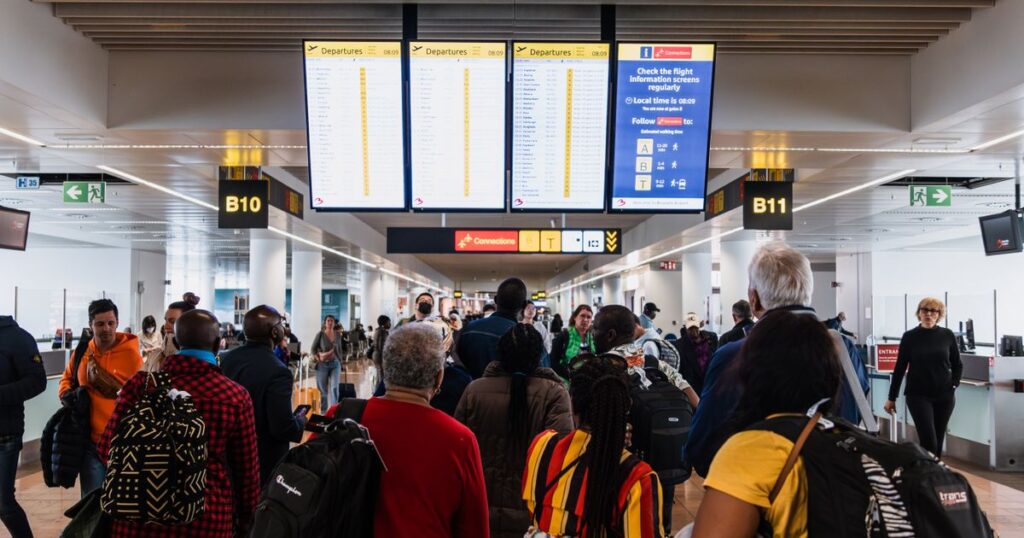
At 3:54pm Eastern Time on Friday, 13 November 2026, the Federal Aviation Administration did something it has done only a handful of times in its history: it told every airport in the United States to stop sending planes into the sky. For more than four hours, nothing took off. Thousands of flights were cancelled, more than 800 planes turned around or diverted, and travellers from Boston to Los Angeles spent the night in terminals. The disruption is still rippling through the system this weekend, less than two weeks before the Thanksgiving rush.
Quick answer: The FAA ground stop began at 3:54pm ET on Friday, 13 November, and was lifted at 8:15pm ET. Transportation Secretary Sean Duffy said ageing switches and routers in the air traffic control network became overloaded with data and started giving inconsistent radar and communications readings, so the system was shut down as a precaution. Officials said there was no sign of a cyberattack. More than 4,700 flights were cancelled on Friday and around 3,300 more were cancelled for Saturday. Check your airline before heading to the airport.
What happened during the FAA ground stop
The trouble started shortly after 3:30pm ET, when air traffic facilities across the country began to see what Duffy later described as instability in radar and communications. The problem hit the Air Route Traffic Control Centers, the 20 facilities in the lower 48 states (plus one in Alaska) that guide planes as they cross the country, along with some of the radar approach facilities near airports.
At 3:54pm ET the FAA issued a nationwide ground stop for all departures, citing “extraordinary circumstances and reasons for safety.” Planes already in the air were allowed to keep flying and land. According to Duffy, about 3,500 aircraft were airborne when the order went out. Inbound international flights were handled case by case.
Duffy announced that the ground stop was lifted at 8:15pm ET, after a little over four hours and twenty minutes. On Saturday the FAA said it had tested its systems to make sure they were stable before letting departures resume.
Timeline of the outage
| Time (ET, Friday 13 Nov) | Time (IST, Saturday 14 Nov) | What happened |
|---|---|---|
| Shortly after 3:30pm | Around 2:00am | Radar and communications instability begins at control centers |
| 3:54pm | 2:24am | FAA orders a nationwide ground stop for all departures |
| About 4:00pm | 2:30am | Around 11,000 flights carrying 1.5 million+ passengers still scheduled to leave US airports (Cirium) |
| 7:05pm | 5:35am | At least 827 flights diverted: 670 back to their origin, 157 elsewhere (Cirium) |
| 8:15pm | 6:45am | Ground stop lifted; departures restart slowly |
| Saturday morning | Saturday afternoon | FAA says systems tested and stable; airlines still cancelling thousands of flights |
What caused it? Old routers, not hackers
At a White House briefing on Friday night, Duffy put the blame squarely on ageing equipment. He said switches and routers in the air traffic control network were flooded with more data than they could handle, which made the information coming out of them unreliable. Rather than let controllers work with inconsistent radar and radio data, the FAA stopped new departures. Duffy stressed that this was not a total loss of radar or communications.
He described the network as running on old analog telecom gear and 1980s copper lines, and said that new technology being added to the system had overloaded the older parts, according to Al Jazeera’s reporting of the briefing.
Homeland Security Secretary Markwayne Mullin initially said nothing could be ruled out. By the evening briefing he told reporters there was no indication of a cyberattack, telling ABC News: “It doesn’t appear that way.” AirSpace Intel, the contractor behind the SMART AI system being rolled out at FAA facilities, said its product was not involved, and Duffy said the failure was in old legacy equipment, not SMART.
The warning signs were already on paper
The outage did not come out of nowhere. A Government Accountability Office report published in September flagged copper cabling dating back to the 1960s and warned that delays in modernising the network could cause more disruptions. The same report noted that upgrades were sometimes scheduled on top of each other, which could overwhelm the system. Aviation experts quoted by Al Jazeera questioned why backup systems did not take over, since redundancy is supposed to be built into every layer of air traffic control.
The ground stop also landed in an already rough week for critical technology. Microsoft’s email and collaboration services suffered a major outage that began on Thursday, which we covered in why Outlook, Teams and Copilot went down.
How many flights were cancelled and delayed?
The numbers shifted all evening as airlines cleared their schedules. Here is where the main trackers landed:
| Measure | Figure | Source |
|---|---|---|
| Flights cancelled on Friday | More than 4,700 | Flightradar24, via Al Jazeera |
| Flights delayed on Friday | About 10,000 | Flightradar24, via Al Jazeera |
| Planes in the air when the stop began | About 3,500 | Sean Duffy, via ABC News |
| Flights diverted by 7:05pm ET | At least 827 | Cirium, via Al Jazeera |
| Saturday cancellations (5:15am ET) | Nearly 3,300 | FlightAware, via Axios |
| Ground stop duration | About 4 hours 21 minutes | FAA and DOT timings |
Axios reported that Atlanta’s Hartsfield-Jackson, New York’s JFK and Boston Logan were the hardest-hit airports on Saturday morning, and that Delta was more affected than United or American. Flights from Europe to the US were also delayed or cancelled. Duffy said college football teams flying on charters this weekend could be given priority.
Why is the FAA ground stop trending?
Nationwide ground stops are extremely rare. ABC News reported that this was only the second time since the 11 September 2001 attacks that every departure in the country was halted. The previous case was in January 2023, when the FAA’s NOTAM system, which gives pilots safety notices before take-off, went down. Al Jazeera described Friday’s stop as the longest in 25 years.
The timing has made it bigger news. Friday afternoon is one of the busiest windows of the week, and the outage arrived just before the Thanksgiving travel period, which is typically among the busiest stretches of the year for US airlines.
Political fallout and the push for funding
Duffy used much of his briefing to press Congress for money, calling the state of the system an emergency and asking for about $50 billion to overhaul air traffic control. He warned that similar outages would happen again without new investment, while insisting that safety systems worked and every airborne flight landed.
Democrats demanded answers. House Democratic leader Hakeem Jeffries called the outage an unprecedented breakdown and asked the administration to explain what went wrong. Senator Tammy Duckworth, the top Democrat on the Senate aviation subcommittee, said she would press the FAA for answers, and Senator Maria Cantwell said the Commerce Committee would review how primary and backup frequencies failed.
What travellers should do now
- Check your flight before you leave home. Airlines are still rebuilding schedules and repositioning crews and aircraft. Use your airline’s app for real-time status.
- Rebook through the app first. Phone lines and airport counters are swamped. Most airlines let you change a cancelled flight online for free.
- Know your refund right. Under US Department of Transportation rules, if an airline cancels your flight and you choose not to travel or not to accept the alternative it offers, you are entitled to a refund of your ticket, whatever caused the cancellation.
- Don’t count on hotel vouchers. Because this outage was caused by the FAA rather than the airline, carriers are not required to pay for meals or hotels, though some may offer them. Ask, and keep receipts.
- Plan Thanksgiving with a buffer. Duffy said he expects operations to be back up before the holiday, but booking early flights and leaving extra connection time is sensible.
This section is general information, not legal advice. Airline policies and DOT rules can change, so check the latest terms with your airline or the DOT.
What happens next?
Expect a busy week in Washington. Congressional committees want briefings, and the FAA’s own review of why redundant systems did not catch the failure will be closely watched. On the ground, Duffy told reporters it would take time to unwind the disruption, and aviation analysts quoted by Al Jazeera said a full recovery could take more than a day because airline networks are so tightly linked through hubs. Duffy’s forecast is that the system will be fully operational for the Thanksgiving peak, which starts in less than two weeks.
Frequently asked questions
What is an FAA ground stop?
A ground stop is an order that keeps departing aircraft on the ground until the FAA clears them to leave. Planes already in flight continue to their destinations. Local ground stops happen often for weather or staffing; a nationwide stop covering every airport is very rare.
Why did the FAA stop all flights on 13 November 2026?
Transportation Secretary Sean Duffy said ageing switches and routers in the air traffic control network were overloaded with data and began producing inconsistent radar and communications information, so the FAA halted departures as a safety precaution.
Was the FAA ground stop a cyberattack?
Officials said there was no indication of one. Homeland Security Secretary Markwayne Mullin said it did not appear to be a cyberattack, and the Transportation Department blamed old equipment.
How long did the ground stop last?
It ran from 3:54pm ET to 8:15pm ET on Friday, 13 November, a little over four hours and twenty minutes.
Can I get a refund for a flight cancelled by the ground stop?
Yes, if the airline cancelled your flight and you decide not to travel or turn down the rebooking it offers, DOT rules entitle you to a refund of the ticket price. Contact your airline to request it.
Sources: FAA, ABC News, Al Jazeera, CNBC, Axios, CNN, Gizmodo, Newsweek, Google Trends.