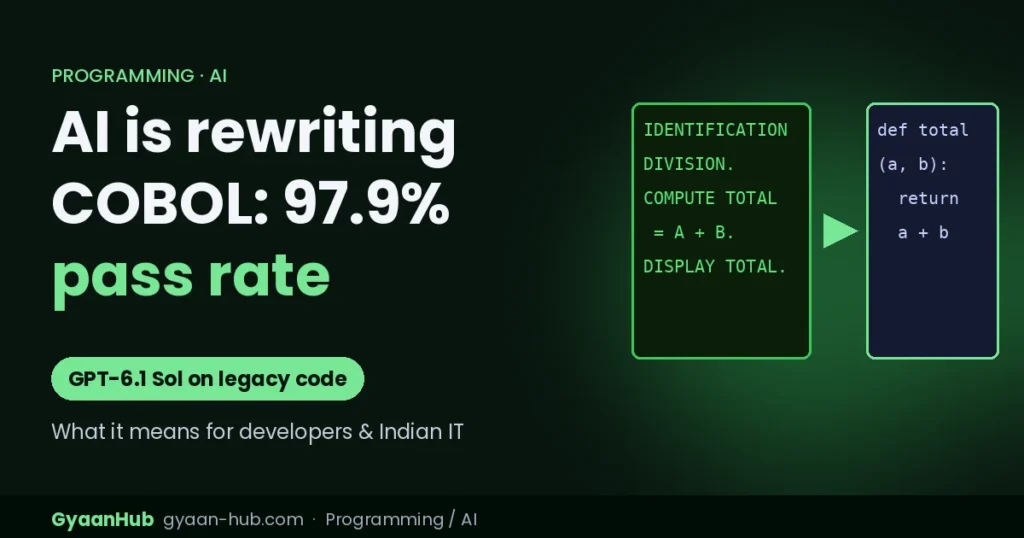
Quick answer: OpenAI says its new GPT-6.1 Sol model scored 97.9% on its COBOL migration test at higher reasoning effort, and 86.6% at low effort. The previous GPT-5.6 Sol scored just 5.4% on the same test. The task: convert real COBOL programs into modern languages like Python, Java or Rust so that every hidden test still passes. If those results hold up outside OpenAI’s lab, AI could change how banks and big companies modernise decades-old software.
Why COBOL still matters in 2026
COBOL is a programming language created in 1959. It sounds ancient, but it still runs huge parts of the financial world:
- COBOL supports more than 40% of online banking systems and around 95% of ATM transactions, according to figures cited in coverage.
- The engineers who know it are retiring, and few new developers learn it.
- Rewriting these systems by hand is slow, expensive and risky, so many organisations keep patching old code.
What OpenAI tested
- The task: take a COBOL program and rewrite it in C++, Java, Kotlin, Python or Rust.
- The bar: hidden tests require byte-for-byte matching output, and a migration counts only if every test passes.
- Results: GPT-6.1 Sol scored 86.6% at low reasoning effort (at 61% of the older model’s cost) and 97.9% at higher effort.
- Second test: on a harder benchmark that asks models to build a SQLite-compatible database engine in 20 languages, OpenAI’s top GPT-6 Astra model averaged 87.4%, and its COBOL score jumped from 10.9% to 72.1%.
Why COBOL is hard for AI
There is far less COBOL code online than Python or JavaScript, so AI models have had little to learn from. COBOL also has quirks that break naive translations. A good example is money maths: COBOL’s fixed-point arithmetic quietly drops extra decimal places unless rounding is requested. A translated program that rounds instead will run without errors but give slightly different financial results, exactly the kind of bug a bank cannot afford.
The caveats
- OpenAI designed and ran both tests itself. No outside group has verified the results yet.
- OpenAI says real migrations still need expert review and testing against the system’s business rules and dependencies.
- Real legacy systems include databases, batch jobs, screens and integrations, far more than a single program.
What it means for developers
- Legacy modernisation is becoming an AI-assisted job. Developers who can validate, test and integrate AI-translated code will be in demand.
- Testing skills matter more than ever. The model is only as trustworthy as the tests that check its output.
- India’s IT services sector, which does a lot of mainframe maintenance and migration work for global banks, is directly affected. Projects that took years could shrink, shifting work from rewriting code to reviewing and testing it.
- Knowing COBOL plus modern languages could become a valuable niche skill during the transition.
Frequently asked questions
What did GPT-6.1 Sol score on the COBOL test?
97.9% at higher reasoning effort and 86.6% at low effort, on OpenAI’s own COBOL migration evaluation.
Is COBOL still used?
Yes, widely in banking and large enterprises, including most ATM transactions.
Can AI fully replace COBOL developers?
Not yet. OpenAI itself says expert review and testing are still required for production migrations.
Which languages can GPT-6.1 Sol convert COBOL into?
The test covered C++, Java, Kotlin, Python and Rust.
Sources: Dataconomy; The Decoder; AI Weekly; The Neuron. Results are as reported by OpenAI.