
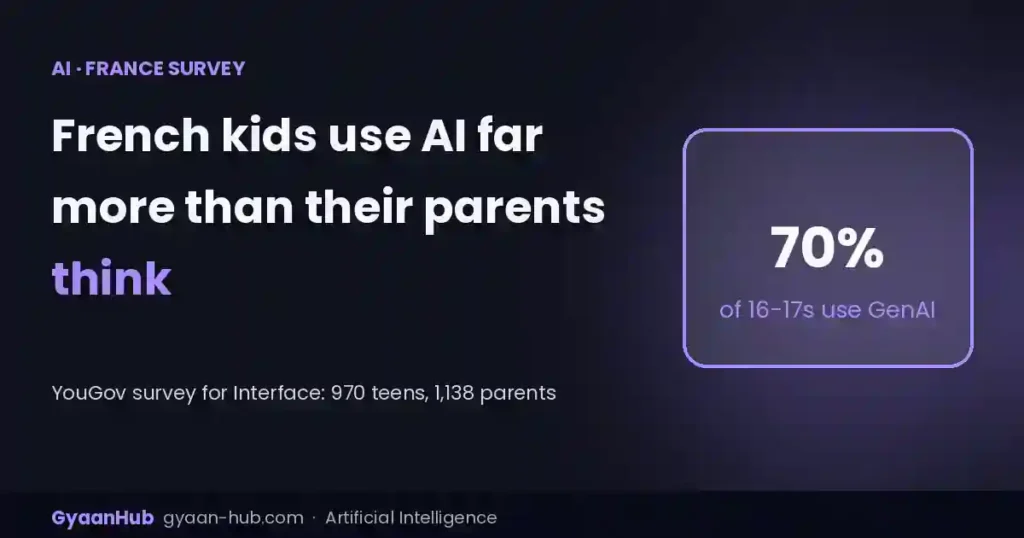
Quick answer: A new YouGov survey for the Berlin-based NGO Interface finds that French children use generative AI much more than their parents realise. 40% of 11–12-year-olds use general-purpose AI tools every week, but only 26% of their parents are aware of it. That is a 14-point gap. Most young users also say they spend more time with AI than they would like.
About the survey
YouGov interviewed 1,138 parents and 970 children aged 11 to 17 in France between 24 and 30 June 2026. The study looked at chatbots, voice assistants, AI built into social media apps, and “AI companions”: apps designed to act like a friend or partner.
Children vs parents: the awareness gap
At every age, children report more regular use of generative AI than their parents estimate:
| Age group | Children who use GenAI regularly | Parents’ estimate |
|---|---|---|
| 11–12 | 56% | 44% |
| 13–15 | 62% | 52% |
| 16–17 | 70% | 61% |
Which AI tools are the youngest using?
Among 11–12-year-olds:
- 33% use voice assistants
- 23% use AI features inside social media apps
- 16% use AI companion apps
AI companions are the most worrying for experts because they are designed to build an emotional bond. As Interface’s Jessica Galissaire put it: “The AI chatbot is also like having a friend that is available 24/7.”
Too much screen time with AI
A striking 92% of young generative AI users say they spend more time with it than they would like. The feeling is strongest for AI companions (59%) and AI inside social media (57%). That pattern looks a lot like the “endless scroll” problem that social networks already have.
Parents feel left alone
- Only 32% of parents feel well supported in guiding their children’s AI use.
- 26% feel supported, but not enough.
- 42% feel they get no support at all.
When asked who should help, parents pointed to teachers and schools (51%), tech platforms (41%) and public authorities (30%).
What should be done?
Galissaire argues that laws alone will not fix the problem: “Regulation in itself will never be enough. Prevention and empowerment must play a huge role as well.” Rather than simply banning children by age, she prefers AI products that are “safe by design”: built from the start with protections for young users.
Policy is moving too. In September the European Commission proposed the EU Kids Act, aimed at strengthening protections for minors online, and several EU countries are debating age limits for social media.
Practical tips for parents (anywhere)
- Ask, don’t assume. Find out which AI apps your child actually uses, including AI features hidden inside apps like Snapchat or Instagram.
- Try the tools together. Using a chatbot side by side helps you explain what AI gets wrong and why it is not a real friend.
- Watch for companion apps. Check app stores and screen-time reports for “AI friend” or role-play apps.
- Set time limits. Most phones let you limit time per app, including AI apps.
- Talk about privacy. Remind children not to share personal details, photos or school information with chatbots.
Frequently asked questions
How many French children use AI weekly?
Among 11–12-year-olds, 40% use general-purpose AI tools weekly, according to the survey.
What is an AI companion?
An app that uses AI to act like a friend, partner or character you can chat with at any time.
What is the EU Kids Act?
A proposal from the European Commission, published in September 2026, to strengthen online protections for children across the EU.
Sources: Euronews (23 October 2026); YouGov survey for Interface, June 2026.