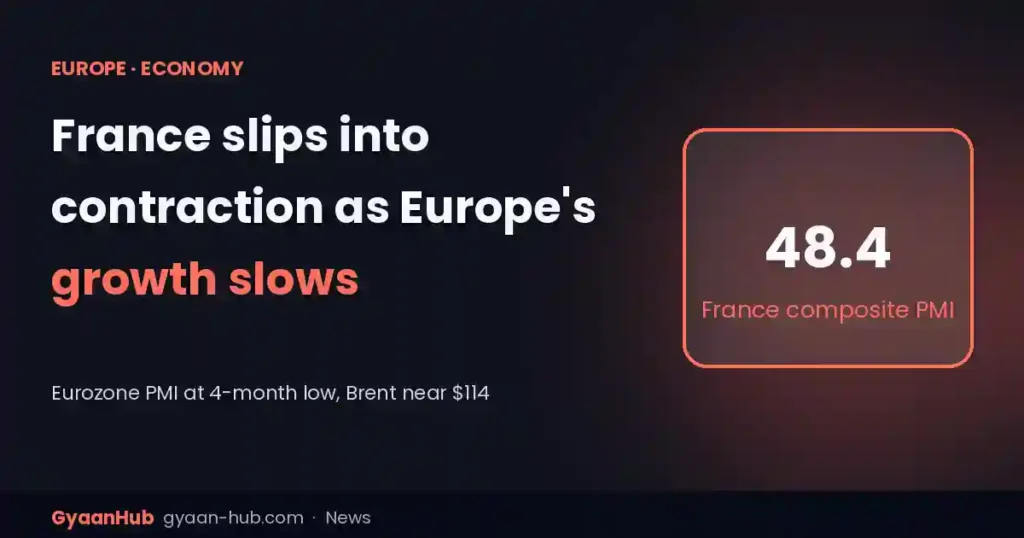
Quick answer: France’s private sector shrank in October 2026. Its composite PMI fell to 48.4 from 51.1, well below the 50.5 economists expected (any reading below 50 means contraction). Across the eurozone, growth slowed to a four-month low of 51.9. Germany is still growing but losing speed. High oil prices, with Brent near $114 a barrel, and political uncertainty in France are the main pressures.
What is a PMI, in one minute?
The Purchasing Managers’ Index (PMI) is a monthly survey of business managers asking whether orders, output, jobs and prices are rising or falling. A reading above 50 signals expansion and below 50 signals contraction. Because it arrives weeks before official GDP data, investors and central banks watch it closely. The figures below come from S&P Global Market Intelligence.
The key numbers
Eurozone
- Composite PMI: 51.9 (September: 53.1; forecast: 52.7), a four-month low.
- Services and manufacturing both weaker than expected, but still expanding.
- S&P Global’s Chris Williamson says the survey points to quarterly GDP growth of about 0.3%.
France
- Composite PMI: 48.4 (September: 51.1).
- Services: 48.4. Manufacturing: 49.3, an 11-month low.
- New orders fell at the fastest pace since May, and exports declined for an 11th straight month.
- Job cuts continued for a sixth month, mostly by not filling vacancies and letting temporary contracts end.
- Business confidence for the next 12 months fell to its lowest level since April 2020.
Germany
- Composite PMI: 52.8, down from an 11-month high of 53.8.
- Manufacturing rose to 54.2, helped by export orders plus defence and infrastructure spending.
- Services slipped to 51.7 as customers delayed decisions.
- Factories reported the fastest rise in input costs since May, driven by oil, raw materials and electronic components.
Why is France struggling?
Economists point mainly to politics and public finances. Joe Hayes of S&P Global said the downturn reflects firms’ worries about “what is shaping up to be a highly uncertain 2027 Presidential Election.” Rory Fennessy of Oxford Economics blamed “the volatile political situation and spike in government borrowing costs.”
Bond markets show the stress clearly:
- France’s 10-year borrowing cost hit 5.14% on Thursday, its highest since 2002, before easing to about 5.04%.
- The gap between French and German 10-year yields widened to 170 basis points, up from 78 in early August.
- France now pays about 45 basis points more than Italy to borrow for ten years. That is a striking reversal, because Italy has long been seen as the riskier borrower.
The oil and interest-rate squeeze
With Brent crude near $114, European manufacturers are paying more for energy, fuel and transport, and supplier delivery times grew by the most in four months. Williamson warned that higher interest rates are “starting to take a toll,” and that the data “will likely add to further speculation of more aggressive policy tightening from the ECB.” This is the classic policy dilemma: inflation pressure says raise rates, while weakening growth says hold back.
Markets reaction
- France’s CAC 40 fell to around 7,750, more than 11% below its 10 August high.
- Italy’s FTSE MIB is more than 10% below its August peak.
- The euro is near $1.12, over 4% below its August high.
Is Europe heading into recession?
Not yet. The eurozone as a whole is still growing, just more slowly. The October surveys do not signal a eurozone-wide recession, but the risk of a further slowdown is significant, especially in France.
Why it matters for India
- Exports: The EU is one of India’s largest trading partners, so weaker European demand can hit textiles, engineering goods, chemicals and IT services.
- IT services: European clients delaying decisions, as German services firms reported, often means slower deal signings for Indian IT companies.
- Oil: Brent near $114 is a direct cost for India as a major crude importer, with knock-on effects on inflation and the rupee.
Frequently asked questions
What was France’s PMI in October 2026?
The composite PMI was 48.4, signalling contraction.
Is Germany also contracting?
No. Germany’s composite PMI was 52.8, still in growth territory, though slower than in September.
Why are French bond yields rising?
Investors are demanding more to lend to France because of political uncertainty ahead of the 2027 presidential election and concerns about government borrowing.
Sources: Euronews (23 October 2026) and S&P Global Market Intelligence flash PMI data, including comments from S&P Global and Oxford Economics economists.