Google Cloud more than doubled its revenue, the Gemini app passed one billion users, and Alphabet’s total sales crossed $127 billion in a single quarter. Investors still sold the stock. Within minutes of Alphabet’s third-quarter 2026 report on Wednesday, October 28, shares fell around 8–10% in after-hours trading, erasing roughly $300 billion in market value on paper and making “Google stock” one of the most-searched terms in the United States. Here is what the numbers actually said, why the market reacted the way it did, and what comes next.
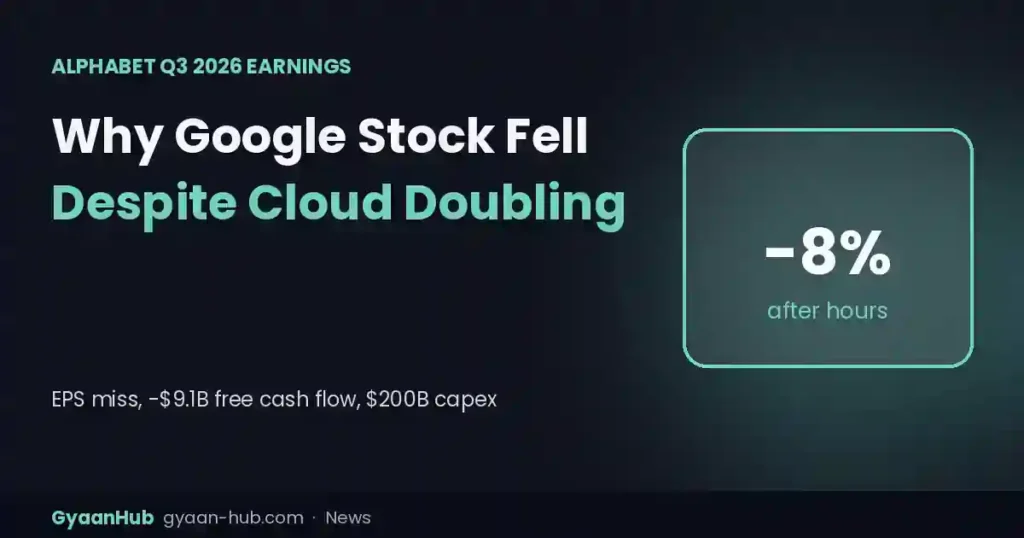
Quick answer: Google stock (GOOGL/GOOG) dropped roughly 8–10% after hours on October 28 because Alphabet’s Q3 2026 earnings per share came in at $2.12, far below the roughly $3.01 Wall Street expected, revenue of $127.6 billion was slightly under forecasts, ad growth was modest, and free cash flow turned negative (about –$9.1 billion) as capital spending hit $51.4 billion in the quarter. The bright spot was Google Cloud, whose revenue more than doubled to $30.7 billion.
What happened to Google stock?
Alphabet reported after the US market close on Wednesday, the same evening as Microsoft. Shares of Class A stock (GOOGL) fell 8.3% to about $299.54 immediately after the release, according to StockStory data carried by Yahoo Finance, with some reports showing an intraday after-hours drop of as much as 10–11%. Microsoft, by contrast, rose more than 5% after hours on its own results, which made the contrast even sharper for investors comparing the two AI giants.
Alphabet was valued at roughly $3.9 trillion going into the report, so even a single-digit percentage move represents an enormous sum. The question on most investors’ minds was simple: how can a company growing revenue by 25% see its stock punished this hard?
Alphabet Q3 2026 earnings: the key numbers
| Metric | Q3 2026 result | Context |
|---|---|---|
| Total revenue | $127.6 billion | Up about 25% year over year; consensus was about $127.9–128.2 billion |
| Diluted EPS | $2.12 | Down from $2.87 a year ago; consensus was about $3.01 |
| Operating income | $40.6 billion | Up 30%; operating margin 31.8% |
| Google Search & other | $63.3 billion | Up 12% |
| YouTube ads | $11.2 billion | Up 9% |
| Subscriptions, platforms & devices | $14.3 billion | Up 11% |
| Google Cloud revenue | $30.7 billion | Up 103%; operating margin 36.2% (vs 23.7% a year ago) |
| Cloud backlog | About $561 billion | Just over 55% expected to be recognised within 24 months |
| Capital expenditure (quarter) | $51.4 billion | Versus about $24 billion a year earlier |
| Free cash flow (quarter) | About –$9.1 billion | Negative for a second straight quarter (about –$5.9 billion in Q2) |
| 2026 capex guidance | $195–205 billion | Unchanged; 2027 expected to rise “significantly” |
Why is Google stock falling? Four reasons
1. A big earnings-per-share miss (mostly on paper)
The headline miss was on profit. Alphabet earned $2.12 per diluted share against expectations of around $3.01. The main culprit was not the core business but Alphabet’s investment portfolio: the company booked a loss of roughly $8.2–8.7 billion on equity securities, driven largely by an unrealised markdown on its stake in SpaceX, according to its results and reporting by Fortune and Yahoo Finance. A year earlier, the same line produced a gain of more than $10 billion. That swing alone accounts for most of the drop in EPS. Operating income, which strips out investment gains and losses, actually rose 30%.
Paper losses do not change the cash in the business, but headline EPS still drives algorithmic trading and first reactions, which helps explain the speed of the sell-off.
2. Ads grew, but not fast enough
Advertising is still the engine that pays for everything else at Alphabet. Search revenue grew 12% and YouTube ads grew 9%, while Google Network ads were nearly flat at about 1% growth. Total ad revenue came in around $82 billion, below the roughly $83.4–83.5 billion analysts had pencilled in. Reports from investingLive noted that search ad growth slowed more than some expected as more users shift to AI Mode, Google’s conversational search experience.
Management pushed back on that worry. Philipp Schindler, Google’s chief business officer, said on the earnings call that “the majority of AI Mode queries are incremental, creating more monetization opportunities over time.” Sundar Pichai added that search query growth was the fastest in five years. Investors, however, appear to want to see that monetisation arrive before they pay up for it.
3. Negative free cash flow
This is the number that worried long-term holders most. Alphabet spent $51.4 billion on capital projects in the quarter, mostly data centres, servers and its own Tensor Processing Unit (TPU) chips, more than double the year-earlier figure. Operating cash flow of $42.3 billion was not enough to cover it, leaving free cash flow at roughly –$9.1 billion. CFO Anat Ashkenazi warned that capital spending and a build-up of TPU inventory “will put pressure on free cash flows.”
For a company long admired as a cash machine, two straight quarters of negative free cash flow mark a real change in character. Earlier this year Alphabet raised about $84.8 billion in new equity, including $10 billion from Berkshire Hathaway, to fund the AI build-out, according to Fortune.
4. Spending will go even higher in 2027
Alphabet kept its 2026 capex guidance at $195–205 billion, but said 2027 spending will increase significantly, with details to come on the fourth-quarter call. Markets tend to dislike open-ended spending commitments, especially when the payback timeline is uncertain. If you want to understand why tech companies are pouring this much money into infrastructure, our explainer on why electricity is now AI’s biggest bottleneck covers the physical side of the race.
The good news investors may be overlooking
Not everything in the report was disappointing. In several areas, Alphabet put up some of its strongest numbers ever:
- Google Cloud is booming. Revenue more than doubled to $30.7 billion and operating income more than tripled to about $11.1 billion. Thomas Kurian said Google Cloud now has 18 product lines that each generate more than $1 billion in annual revenue.
- A $561 billion backlog. Cloud contracts already signed but not yet recognised as revenue give unusual visibility into future growth.
- Gemini reaches 1 billion users. The Gemini app crossed the one-billion-user mark, and Google’s first-party model APIs are processing nearly 32 billion tokens per minute, more than four times the level of a year ago.
- TPUs are becoming a business. Google said it has more than 100 significant TPU customers. Earlier in the week, Oracle announced it would buy Google’s TPUs for its own data centres. TD Cowen analyst John Blackledge has forecast billions of dollars in TPU sales over the next few years.
- Waymo keeps expanding. The self-driving unit has logged more than 300 million fully autonomous miles and operates in 15 major US cities.
- Dividend continues. Alphabet declared a quarterly dividend of $0.22 per share, payable in December.
Pichai summed up management’s view bluntly: “Q3 was a strong quarter for Alphabet.” He also said Alphabet’s annual revenue has now passed $400 billion for the first time.
Why “Google stock” is trending right now
Several factors pushed the search term to more than 200,000 searches in the US within a day, according to Google Trends:
- Alphabet is one of the largest holdings in most US index funds and 401(k) plans, so a sharp move affects millions of ordinary investors.
- It reported on the same night as Microsoft, inviting a direct comparison of the two biggest AI cloud spenders.
- The AI trade is under scrutiny. Last week, concerns about CoreWeave’s debt load dragged on AI-related stocks, and Anthropic’s recent IPO filing has put fresh attention on AI valuations. (We broke down the Anthropic IPO prospectus here.)
- Competition is heating up. Meta’s new Muse AI agent, which Mark Zuckerberg says 10 million people have set up, mostly for shopping, is seen by some analysts as a long-term challenge to Google’s commercial search.
What analysts are watching next
Before the report, Bank of America analyst Justin Post flagged “TPU sales-driven upside” and a “competitive agentic offering” as potential catalysts, along with a broader Gemini 4 launch. After the report, the debate has shifted to three questions:
- When does capex peak? The size of the 2027 increase, due on the Q4 call in early 2027, will be the single biggest factor for the stock.
- Can AI Mode be monetised as well as classic search? Search still makes up about 53% of Alphabet’s revenue, so even small changes in ad pricing matter.
- Will Cloud margins hold? Management warned of near-term margin pressure because Google is renting third-party compute capacity to meet demand.
Thursday’s regular trading session (which opens at 9:30 a.m. ET) will show whether the after-hours drop sticks or whether buyers step in, as they have after several previous post-earnings dips in big tech.
Disclaimer: This article is for information only and is not financial advice. Stock prices can move sharply after earnings. Do your own research or consult a licensed financial adviser before making investment decisions.
Frequently asked questions
Why did Google stock drop after earnings?
Mainly because earnings per share of $2.12 missed estimates of about $3.01, ad revenue grew more slowly than hoped, and free cash flow turned negative at about –$9.1 billion due to heavy AI spending. Much of the EPS miss came from an unrealised loss on Alphabet’s investments, including SpaceX.
How much did Alphabet make in Q3 2026?
Alphabet reported revenue of $127.6 billion, up about 25% year over year, and operating income of $40.6 billion. Google Cloud contributed $30.7 billion in revenue.
How much is Google spending on AI?
Alphabet spent $51.4 billion on capital expenditure in Q3 alone and expects $195–205 billion for all of 2026. It said spending will rise significantly again in 2027.
Is Google Cloud growing?
Yes. Google Cloud revenue grew 103% year over year to $30.7 billion, its operating margin rose to 36.2%, and its contracted backlog stands at about $561 billion.
Does Alphabet still pay a dividend?
Yes. Alphabet declared a quarterly dividend of $0.22 per share, payable in December 2026.
Sources: Alphabet Q3 2026 earnings release and call (via MarketBeat transcript summary), Fortune, The Motley Fool, Yahoo Finance (StockStory), investingLive, Yahoo Finance earnings preview, Google Trends.