ExxonMobil just posted one of its strongest quarters in years, and the unusual part is where the money came from. For the third quarter of 2026, the biggest US oil company earned $15.4 billion, and for once its refineries made more money than its oil and gas wells. With diesel and gasoline in short supply around the world, “xom stock” is now one of the top trending searches in the US as investors work out what the numbers mean.
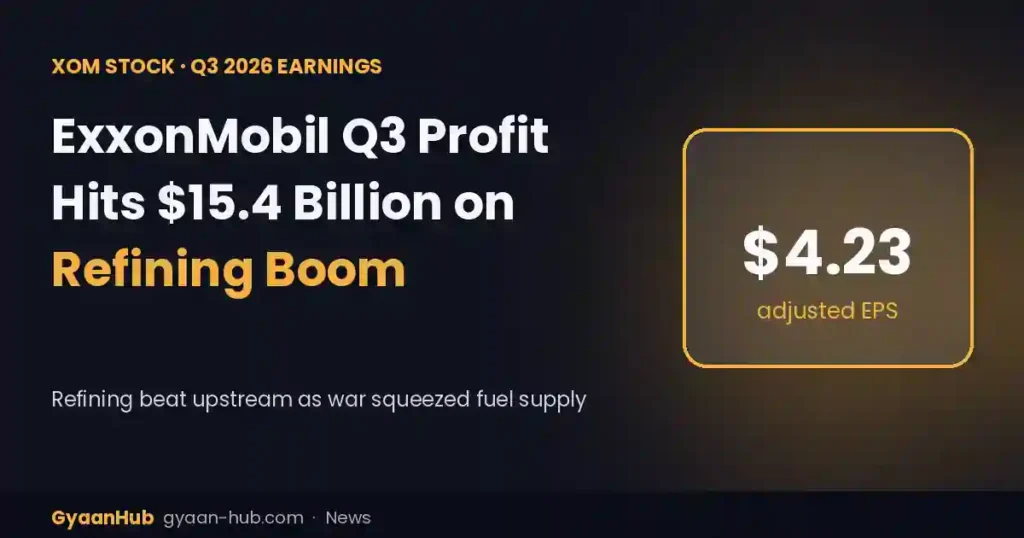
Quick answer: ExxonMobil reported Q3 2026 GAAP earnings of $15.4 billion ($3.72 per share) and adjusted earnings of $17.5 billion ($4.23 per share) on October 30, 2026. That beat the LSEG analyst estimate of $4.08 per share. Refining (Energy Products) earned about $9.1 billion on an adjusted basis, more than the upstream oil and gas business, because wars in the Middle East and Ukraine cut global fuel-making capacity. Exxon also announced a $20 billion share buyback for 2027 and a $1.07 quarterly dividend.
What ExxonMobil reported
ExxonMobil published its third-quarter results on Friday, October 30, 2026. The headline numbers were higher than the second quarter and higher than Wall Street expected:
- GAAP earnings: $15.4 billion, up from $14.5 billion in Q2 2026.
- Earnings per share (GAAP): $3.72, up from $3.48.
- Earnings excluding identified items (adjusted): $17.5 billion, up $2.8 billion from Q2.
- Adjusted EPS: $4.23, compared with an average analyst estimate of $4.08 compiled by LSEG, according to Reuters.
Reuters also reported that adjusted earnings of $17.5 billion came in above the LSEG consensus of $16.6 billion. Reports put the GAAP profit at roughly double the level of a year earlier.
Key numbers at a glance
| Metric | Q3 2026 | Q2 2026 |
|---|---|---|
| GAAP earnings | $15.4B | $14.5B |
| GAAP EPS | $3.72 | $3.48 |
| Adjusted earnings | $17.5B | $14.7B |
| Adjusted EPS | $4.23 | $3.52 |
| Upstream (adjusted) | $7.3B | $9.2B |
| Energy Products / refining (adjusted) | $9.1B | $4.1B |
| Chemical Products (adjusted) | $0.7B | $1.2B |
| Specialty Products (adjusted) | $1.3B | $1.0B |
| Cash flow from operations | $25.7B | $23.6B |
| Free cash flow | $19.1B | $17.2B |
| Upstream production | 4.50M boe/d | 4.51M boe/d |
Figures from ExxonMobil’s Q3 2026 earnings release. Adjusted figures exclude identified items.
Why refining beat oil production this quarter
For most big oil companies, the upstream business (finding and pumping oil and gas) is the profit engine, and refining is the steadier, lower-margin side. This quarter flipped that.
Exxon’s Energy Products segment, which includes its refineries, earned about $9.1 billion on an adjusted basis, more than double the second quarter. Reuters reported that Exxon’s refining earnings beat its upstream earnings for the first time in at least six years.
The reason is supply. Reuters linked the surge in refining margins to the US-Israeli war on Iran, the Russia-Ukraine war, the effective closure of the Strait of Hormuz, and attacks on refineries in Saudi Arabia and Russia. Together these knocked out a large amount of fuel-making capacity and caused diesel shortages around the world. When fuel is scarce, the gap between the price of crude oil and the price of finished fuels (the “crack spread”) widens, and companies that own refineries profit.
Exxon was well placed to benefit. The company said its US Gulf Coast refineries ran at 100% crude unit utilization during the quarter, and Reuters reported that they reached their second-highest diesel output on record. CEO Darren Woods credited past investments, including the Beaumont refinery expansion, with increasing the company’s distillate (diesel and jet fuel) production by about 40% since 2019. “These are lasting improvements, not simply the result of favorable prices and margins,” Woods said in the release.
Why upstream earnings fell
The upstream business still made $7.3 billion on an adjusted basis, but that was about 20% lower than the second quarter. Exxon blamed lower oil prices compared with the prior three months and the effect of an accelerated “entitlement” adjustment in Guyana. Oil prices swung widely: Reuters reported that Brent crude’s spot price ranged from about $68 to $132 a barrel during the third quarter. Production was roughly flat at about 4.5 million barrels of oil equivalent per day.
Buybacks, dividend and debt
For shareholders, the capital return plan matters as much as the profit figure. Here is what Exxon announced:
- Q3 shareholder distributions: $9.4 billion, made up of $4.3 billion in dividends and $5.1 billion in share repurchases.
- 2027 buyback: $20 billion, assuming reasonable market conditions. Reuters noted this is the same level as the 2026 program.
- Q4 dividend: $1.07 per share, payable December 10, 2026, to shareholders of record on November 16, 2026. Exxon says it has raised its annual dividend for 44 years in a row.
- Net debt: $22.1 billion at September 30, 2026, after cutting net debt by nearly $11 billion so far this year.
Exxon CFO Neil Hansen acknowledged that high fuel prices hurt consumers. “It’s important to acknowledge that these higher fuel prices put real pressure on families and businesses,” he said, according to Reuters, adding that the company would “pull every lever that’s available to us to increase supply.”
How Exxon compares with Chevron, Shell and others
Exxon was not alone. Chevron also reported on October 30 and beat estimates, with adjusted earnings of $5.28 per share. Reuters reported that Chevron’s downstream (refining) earnings were its highest in at least six years. A day earlier, Shell and TotalEnergies also reported higher-than-expected profits, and BP’s profit jumped as well. The pattern is clear: across the sector, refining has become the big winner from this year’s supply shocks.
Chevron CFO Eimear Bonner summed up the industry’s cautious stance on the windfall: “We think in decades, not quarters.” Both companies are using the extra cash mainly to strengthen their balance sheets rather than to raise payouts sharply.
Big Tech has also been reporting this week. If you follow earnings season, see our breakdown of why Google stock fell after Alphabet’s Q3 2026 results.
Why “xom stock” is trending
Several things pushed ExxonMobil into the US top searches on Friday:
- Earnings day: The results came out before the US market opened, so investors searched for the share price reaction.
- A clear beat: Both adjusted EPS and total adjusted earnings came in above consensus.
- Fuel prices and politics: High gasoline and diesel prices are a political issue ahead of the US midterm elections on Tuesday, November 3. Reuters noted that President Trump considered a diesel export ban in September before saying in early October that he would not impose one.
- Market mood: Wall Street closed higher on Thursday, and Dow futures were also trending as traders positioned for Friday’s session.
Earlier in the week, XOM shares traded around $181, close to their 52-week high of about $185, according to StockAnalysis data. Live prices change quickly on earnings days, so check your broker or a market data site for the latest quote.
Background: how Exxon got here
Exxon has spent the last several years cutting costs and investing in a few large, low-cost assets. In this release it said its cumulative structural cost savings since 2019 have reached $16.9 billion. It also highlighted that its Guyana operations and its Kearl oil sands project in Canada have each passed 1 billion barrels of cumulative production.
The company is still expanding. It said it has taken over as operator of Papua LNG in Papua New Guinea and agreed to raise its stakes in the Papua LNG projects (to 34%) and in Rovuma LNG in Mozambique (to 50%). It also approved the Rose carbon storage project and started up a carbon capture project with Nucor.
Power demand from AI is another long-term theme for energy companies. We covered that in our explainer on why electricity is now AI’s biggest bottleneck.
What’s next for ExxonMobil
- Fuel margins: Refining profits depend on how long the supply disruptions last. If the Strait of Hormuz reopens fully or damaged refineries come back online, margins could fall back.
- Oil prices: Brent swung by more than $60 a barrel in the quarter, so upstream earnings could move sharply in either direction.
- Political pressure: With the midterms days away, fuel prices and oil-company profits are likely to stay in the headlines.
- Dates to watch: The record date for the next dividend is November 16, 2026, and payment is on December 10, 2026. Exxon’s fourth-quarter results are expected in early 2027.
Disclaimer: This article is for information only and is not financial advice. Stock prices can move quickly and past performance is not a guide to future returns. Do your own research or speak to a licensed financial adviser before investing.
Frequently asked questions
How much did ExxonMobil earn in Q3 2026?
ExxonMobil earned $15.4 billion ($3.72 per share) on a GAAP basis in the third quarter of 2026. Excluding identified items, it earned $17.5 billion ($4.23 per share).
Did Exxon beat earnings estimates?
Yes. Reuters reported that adjusted EPS of $4.23 beat the LSEG average estimate of $4.08, and adjusted earnings of $17.5 billion beat the $16.6 billion estimate.
Why were Exxon’s refining profits so high?
Wars in the Middle East and Ukraine, the effective closure of the Strait of Hormuz and attacks on refineries cut global fuel-making capacity. That widened the gap between crude prices and fuel prices, and Exxon’s Gulf Coast refineries ran at full capacity to take advantage.
What is Exxon’s next dividend?
Exxon declared a fourth-quarter dividend of $1.07 per share, payable on December 10, 2026, to shareholders of record on November 16, 2026.
How big is Exxon’s 2027 share buyback?
Exxon plans $20 billion of share repurchases in 2027, assuming reasonable market conditions. That matches its 2026 buyback level.
Sources: ExxonMobil Q3 2026 earnings release, Reuters, Bloomberg, StockAnalysis, Google Trends.