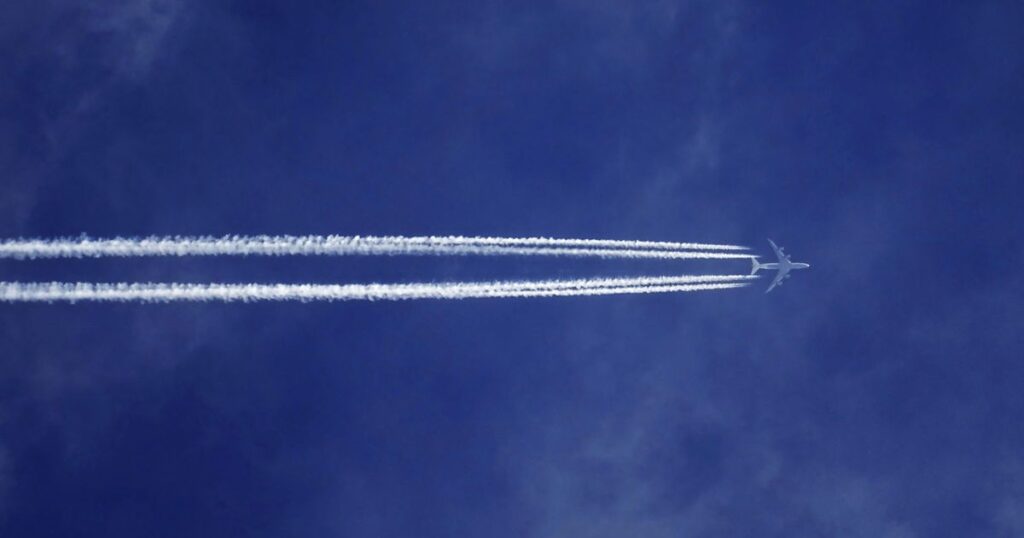
Look up on a clear day and you’ll often see thin white lines streaking across the sky behind planes. Why do planes leave trails? They’re called contrails, short for “condensation trails,” and they’re simply clouds made by jet engines. Here’s how they form, why some last for hours, and why climate scientists are paying close attention to them.
Quick answer: Jet engines burn fuel and release hot, humid exhaust. At cruising altitude, around 8–12 km up, the air is extremely cold, often colder than −40°C. The water vapour in the exhaust quickly condenses and freezes onto tiny soot particles, forming ice crystals: a contrail. If the surrounding air is dry, the trail vanishes in seconds. If it’s humid, it can spread into wide cirrus-like clouds that last for hours.
How contrails form
When jet fuel burns, it produces carbon dioxide, water vapour and tiny particles of soot. Think of it like your breath on a cold winter morning:
- Hot, wet exhaust leaves the engine.
- It meets freezing air high in the atmosphere.
- The water vapour condenses onto soot and other particles.
- It freezes into ice crystals within moments, forming a visible line.
There’s usually a small gap right behind the engine before the trail appears, because the exhaust needs a split second to cool.
Why some contrails vanish and others spread
| Contrail type | Air conditions | What you see |
|---|---|---|
| Short-lived | Dry upper air | Trail disappears within seconds or minutes |
| Persistent | Humid, ice-saturated air | Trail lasts a long time |
| Spreading (contrail cirrus) | Very humid air with wind | Trails widen into sheets of thin cloud covering large areas |
That’s why on some days the sky fills with criss-crossing lines, while on others planes leave almost nothing.
Can contrails predict the weather?
Sometimes. Long-lasting, spreading contrails mean the upper atmosphere is humid. That often happens ahead of an approaching weather front, so persistent trails can hint that cloudier, wetter weather may arrive within a day or so. It’s an old pilots’ and sailors’ rule of thumb, not a precise forecast.
Contrails and climate change
Here’s the surprising part: contrails may warm the planet more than many people realise. Thin ice clouds let much of the Sun’s light through but trap heat rising from Earth, especially at night. A major 2021 study led by David Lee in the journal Atmospheric Environment estimated that the warming effect of contrail cirrus was larger than that of the CO2 from aviation so far, though with much more uncertainty.
The good news is that contrails are short-lived, so cutting them could help quickly. Researchers and airlines, including trials by Google with American Airlines, are testing small altitude changes to avoid the humid layers where long-lasting contrails form.
Contrails aren’t “chemtrails”
Online conspiracy theories claim contrails are “chemtrails” sprayed on purpose. Scientists have studied this repeatedly and found no evidence. A survey of 77 leading atmospheric chemists and geochemists published in 2016 found that 76 of them saw no sign of a secret spraying programme. Contrails are explained by simple physics: water, cold air and soot.
Other trails in the sky
- Wingtip vortices: on humid days, low pressure above wings can cause brief white streaks or “mist” around the wings during take-off and landing.
- Distrails: occasionally a plane flying through a thin cloud clears a gap, leaving a dark line instead of a white one.
Curious about why the sky behind those trails is blue? Read why the sky is blue.
Frequently asked questions
Why do planes leave trails in the sky?
Hot, humid exhaust from jet engines freezes into ice crystals in the very cold air at cruising altitude, forming clouds called contrails.
Why do some plane trails last longer than others?
It depends on humidity. In dry air they vanish quickly. In humid air they persist and can spread into wide clouds.
Are contrails bad for the environment?
Studies suggest contrails add to global warming by trapping heat, possibly as much as or more than aviation’s CO2 so far, though estimates are uncertain.
Are chemtrails real?
No. Scientific studies have found no evidence of secret spraying. Contrails are explained by ordinary physics.
Sources: NASA, NOAA, Lee et al., Atmospheric Environment (2021), Environmental Research Letters (2016 expert survey), Google Research.