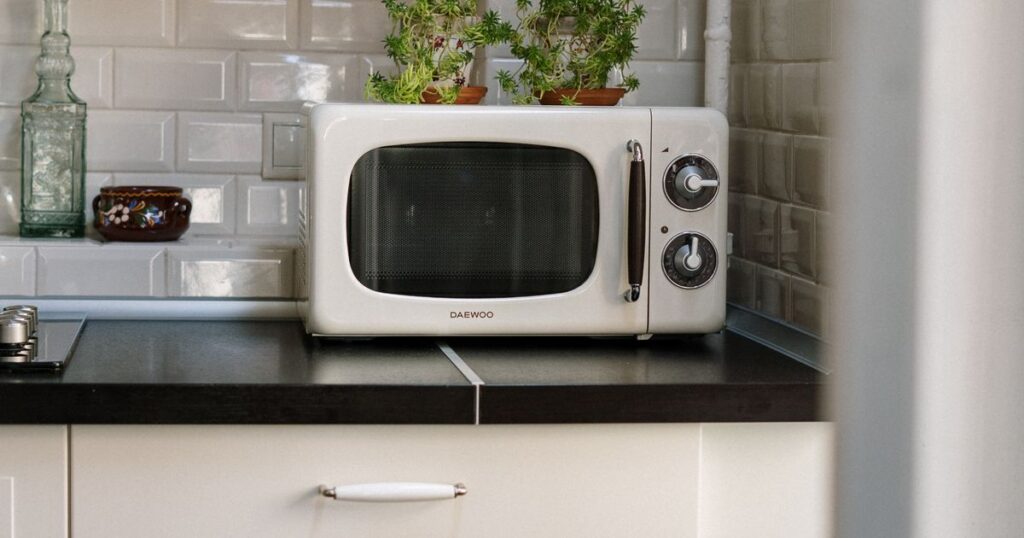
Almost every kitchen has one, but how does a microwave work? It doesn’t heat food from the outside like a normal oven. Instead, it makes the water inside the food heat itself. Here’s the science, why you still get cold spots, why metal sparks, and whether microwaving is safe.
Quick answer: A microwave oven uses a device called a magnetron to produce microwaves, a type of radio wave, usually at 2.45 GHz. These waves make water molecules in food flip back and forth billions of times a second, and that motion creates heat. Microwaves don’t make food radioactive, and the metal mesh in the door keeps the waves inside.
How does a microwave work? Step by step
- Power in: the oven boosts household electricity to a high voltage.
- The magnetron: this vacuum tube turns that energy into microwaves.
- Into the box: a channel guides the waves into the metal cooking chamber, where they bounce off the walls.
- Water spins: water molecules have a positive end and a negative end. The microwaves’ electric field flips direction about 2.45 billion times a second, and the molecules keep trying to line up with it.
- Heat: all that jostling creates friction-like heat that spreads through the food.
This is called dielectric heating. Fats and sugars heat this way too, which is why jam filling can get dangerously hot.
A melted chocolate bar started it all
In 1945, American engineer Percy Spencer was working on radar equipment at the company Raytheon when he noticed a chocolate bar in his pocket had melted. He experimented with popcorn and eggs, and Raytheon patented the microwave oven. Early models in the late 1940s were nearly as tall as a person. Countertop versions became common in homes in the 1970s.
Why microwaves heat food unevenly
| Cause | What happens | Fix |
|---|---|---|
| Standing waves | Waves overlap and create hot and cold spots in fixed places | The turntable moves food through them; stir halfway |
| Limited depth | Microwaves only penetrate a few centimetres | Spread food out, use shallow dishes |
| Frozen food | Ice absorbs microwaves poorly compared with liquid water | Use the defrost setting and let it rest |
| Uneven shapes | Thin edges overcook while centres stay cold | Put thicker parts towards the outside |
The “let stand” instruction on ready meals matters: resting time lets heat spread to the cold spots.
Why metal sparks in the microwave
Metal reflects microwaves instead of absorbing them. Sharp edges and thin metal, like foil, fork prongs or a gold rim on a plate, can concentrate the electric charge until it jumps through the air as a spark. That can damage the oven or start a fire. Smooth metal walls are fine, which is why the oven’s own inside is metal.
Is microwaved food safe?
- No radioactivity: microwaves are non-ionising radiation, like radio waves. They heat food but don’t change its atoms or make it radioactive.
- Nutrients: because cooking is fast and uses little water, microwaving can keep nutrients as well as or better than boiling, according to Harvard Health.
- Leaks: the metal mesh in the door has holes far smaller than the microwaves’ 12 cm wavelength, so waves can’t escape. US federal rules strictly limit leakage. Don’t use an oven with a damaged door or seal.
- Containers: use dishes labelled microwave-safe. Some plastics can soften or release chemicals when hot, so glass or ceramic is a good choice.
- Food safety: heat leftovers until steaming hot all the way through, stirring halfway, to kill bacteria in cold spots.
Microwave tips that work
- Cover food loosely to trap steam and heat more evenly.
- Arrange food in a ring, leaving the middle empty.
- Add a splash of water to rice or pasta before reheating.
- Never heat sealed containers or whole eggs in their shells. They can burst.
- Be careful with plain water: it can superheat past boiling and erupt when disturbed. Put a wooden stirrer or microwave-safe spoon in the cup.
Like everyday science? Read how noise-cancelling headphones work and how GPS works.
Frequently asked questions
How does a microwave heat food?
Microwaves make water molecules in food flip back and forth billions of times a second, and that motion produces heat.
Do microwaves make food radioactive?
No. Microwaves are non-ionising radiation. They heat food but don’t make it radioactive.
Why does my microwave leave cold spots?
Microwaves form fixed hot and cold spots and only reach a few centimetres into food. Stirring, covering and resting help.
Why can’t you put metal in a microwave?
Thin or sharp metal can build up charge and spark, which can damage the oven or cause a fire.
Sources: U.S. Food and Drug Administration (FDA), Harvard Health Publishing, Smithsonian Magazine, World Health Organization.