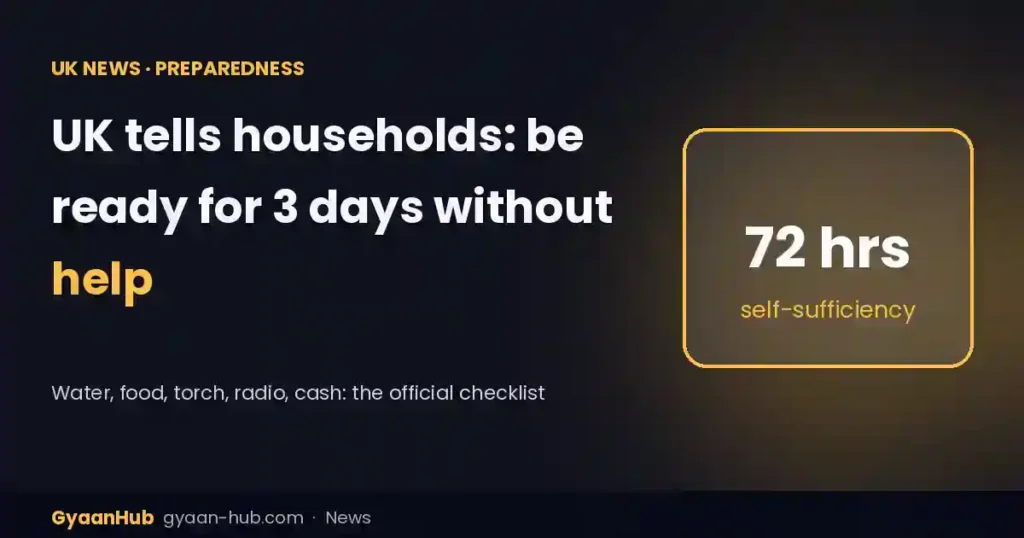
Quick answer: On 23 October 2026, the UK government published guidance asking every household to be able to look after itself for three days if a national emergency cuts off normal services. The checklist covers bottled water, non-perishable food, a torch, batteries, a radio, hand sanitiser, some cash, copies of important documents, and blankets or warm clothing.
The message is simple: “take a few simple steps to stay prepared if everyday services are temporarily disrupted.” Ministers say this is about being alert, not alarmed.
What exactly does the UK checklist ask for?
The guidance, posted on a government website and promoted on social media, recommends keeping:
- Water: a three-day supply of bottled water for everyone in the home.
- Food: three days of non-perishable food that needs little or no cooking.
- Light and power: a torch and spare batteries.
- Information: a radio, so you can still get updates if phones and the internet go down.
- Hygiene: hand sanitiser.
- Money: some cash, in case card payments stop working.
- Paperwork: copies of important documents.
- Warmth: blankets and warm clothing.
People are also encouraged to sign up for government support and alert services.
Who announced it, and why now?
Security Minister Dan Jarvis set out the plan in a written statement to Parliament. He pointed to last winter’s storms and this summer’s wildfires, which disrupted phones, power, water and internet services in parts of the country. He also said the move brings the UK in line with European neighbours that already use a similar “72-hour” message.
Defence Secretary Wes Streeting said people should be ready for supply-chain disruption caused by “hostile state actors or terrorists”, while stressing he wants the public to be alert but not alarmed. Reports also list extreme weather, drought, flooding, AI-related risks and hostile activity from Russia and Iran among the threats being planned for.
The political background
According to Bloomberg, the campaign was planned under Keir Starmer’s government, but Prime Minister Andy Burnham delayed the launch over concerns it could look too gloomy early in his premiership. It now arrives just before Chancellor John Healey’s budget next week, where defence spending is expected to be a major theme. Healey wants defence spending to reach 3.5% of GDP by 2035.
Is this unusual? How Europe does it
Not really. Several European countries already publish household readiness advice built around a similar 72-hour window. The idea is that, in a large-scale emergency, emergency services need the first few days to reach the most vulnerable people. If most households can manage on their own for that period, help can go where it is needed most.
Water security is also part of the wider conversation in the UK. Hotter summers and planned data centres are pushing up demand, and the country has not built a new reservoir since 1992.
Should you start stockpiling?
The key word is steady, not sudden. Retailers have already warned against alarm. Jim Bligh of the British Retail Consortium noted that panic buying is easy to trigger, as people saw with empty shelves in March 2020. A sensible approach:
- Add a few extra long-life items to your normal shop over several weeks, instead of one big trip.
- Store water in a cool, dark place and rotate it, along with food, before it expires.
- Keep a small “grab bag” with a torch, batteries, radio, chargers, cash and document copies.
- Plan for anyone in your home with special needs: medicines, baby supplies or pet food.
- Write down important phone numbers on paper in case your phone is dead.
Frequently asked questions
Is the UK expecting an emergency right now?
No specific emergency has been announced. The guidance is general preparedness advice, partly prompted by recent storms and wildfires.
How much water should I store?
The guidance asks for a three-day supply of bottled water. A common rule of thumb used by emergency agencies is about 2 litres of drinking water per person per day, plus extra for basic hygiene.
Does this apply outside the UK?
The advice is aimed at UK households, but the checklist is good practice anywhere that faces storms, floods, heatwaves or power cuts, including many parts of India.
Sources: The National (23 October 2026), Bloomberg reporting cited therein, and UK government statements.