
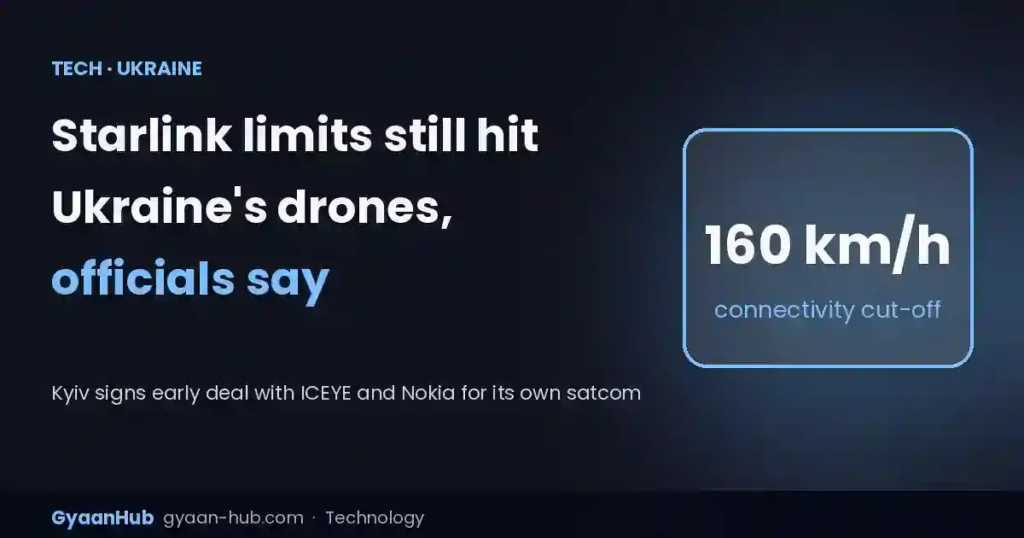
Quick answer: Ukrainian defence officials said on 23 October 2026 that restrictions on Starlink and its military version, Starshield, have not been fully lifted along the front line. Terminals still lose connection when moving at around 160–161 km/h, which disrupts fast-moving strike and interceptor drones. That contradicts US President Donald Trump’s claim that Elon Musk had removed the limits.
What is going wrong?
Starting on 14 October, Starshield terminals used by Ukrainian forces began dropping connectivity once they passed speeds of roughly 160 km/h. That matters because many modern drones fly faster than that. Officials say the disruption hit:
- Mid-range strike drones that rely on satellite links to reach targets far behind the front line.
- Interceptor drones used to shoot down Russian attack drones over Ukrainian cities.
Serhii Beskrestnov, an adviser to President Zelenskyy known by the call sign “Flash”, wrote: “We are currently seeing no indication that the Starlink restrictions have been lifted.” He said rare cases of terminals working slightly above the limit are probably due to SpaceX’s algorithms or specific conditions, not a real change in policy.
What did Trump say?
According to The Wall Street Journal, Trump called Musk on 21 October to ask him to lift the Starshield restrictions. Trump later said Musk had removed the speed limits, though he did not confirm whether he had personally contacted Musk. After the call, some American and Ukrainian officials reported an improvement, but others cautioned that full functionality had not returned.
Who ordered the limits?
That is still disputed. The Wall Street Journal reported that Musk ordered the restrictions, while other accounts suggested possible White House involvement. Trump has denied ordering the move, and neither SpaceX nor the US administration has publicly taken responsibility.
Why would a satellite service limit speed at all?
Consumer satellite internet is designed for homes, ships, planes and vehicles, not weapons. A speed-based cut-off is a simple technical way for a provider to block use in fast, guided munitions without switching off the service completely. The downside, as Ukraine is finding, is that the same limit also breaks legitimate defensive uses like interceptor drones. It is a clear example of how a private company’s software settings can shape a war.
Ukraine’s plan B: a sovereign satellite network
On Thursday, Ukraine’s Defence Ministry signed a letter of intent with two Finnish companies, ICEYE (known for radar-imaging satellites) and Nokia, to explore a satellite communications system Ukraine would control itself. President Zelenskyy announced the deal during a visit to Kyiv by Finnish Prime Minister Petteri Orpo, calling it important for Ukraine’s defence and resilience.
- ICEYE CEO Rafal Modrzewski said Ukraine needs satellite communications it controls.
- Mikko Hautala, chairman of Nokia Defense, said the partnership would give Ukraine control over the connectivity it relies on.
The agreement is at a very early stage, so for now Ukraine still depends on Starlink for critical battlefield communications.
The bigger tech lesson
This episode is pushing governments everywhere to think about digital sovereignty: who controls the networks, clouds and satellites a country depends on. Europe is already funding its own satellite constellation plans, and countries including India are investing in domestic satellite and space capabilities for the same reason. When one company’s settings can change outcomes on a battlefield, owning critical infrastructure becomes a strategic priority.
Frequently asked questions
What is Starshield?
Starshield is SpaceX’s government and military-focused version of its Starlink satellite network.
At what speed do the terminals lose connection?
Ukrainian officials say connectivity drops at around 160–161 km/h.
Has the restriction been lifted?
As of 23 October 2026, Ukrainian defence officials say it has not been fully lifted, despite some reported improvement.
Sources: Euronews (23 October 2026), The Wall Street Journal reporting cited therein, and statements by Ukrainian officials, ICEYE and Nokia.