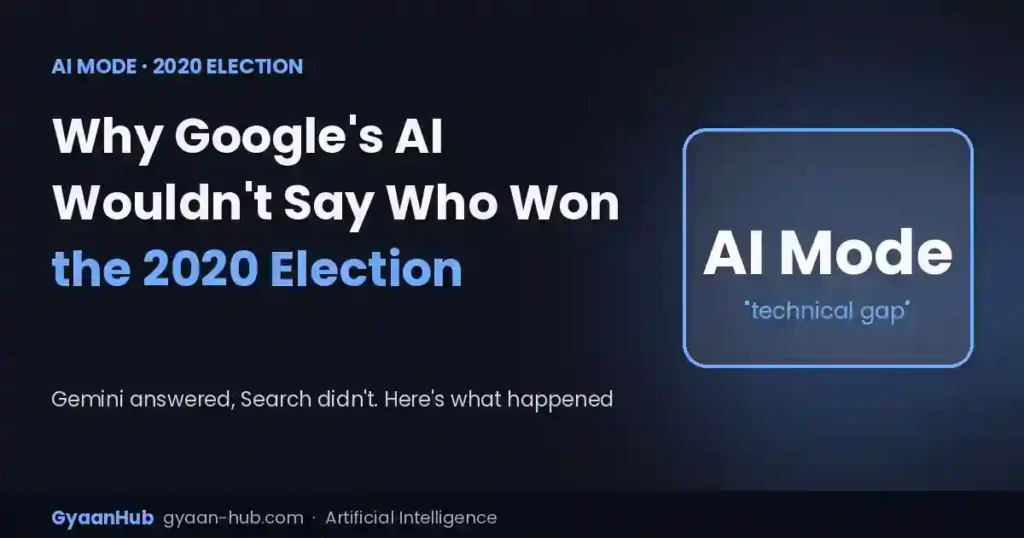
It is one of the easiest questions in recent American history to answer, yet this week Google’s AI could not answer it. When people in the US asked Google Search’s AI Mode “Who won the 2020 election?”, the tool sent them to government documents instead of naming Joe Biden. It had no trouble saying who won in 2016 and 2024. Screenshots spread quickly, Google said there was a “technical gap”, and “who won the 2020 election” has become one of the top trending searches in the US just days before the November 3 midterms.
Quick answer: Joe Biden won the 2020 US presidential election, beating Donald Trump by 306 electoral votes to 232. This week, Google’s AI Mode in Search refused to name the winner for US users and pointed them to the FEC and National Archives instead, even though it answered clearly for users in the UK and Google’s Gemini app answered correctly. Google said there was “a technical gap with 2020” that also affected 2022 Senate races, and said it was fixing it. By October 29, Newsweek found AI Mode naming Biden.
What happened
On Wednesday, October 28, 2026, users began posting screenshots on X showing Google’s AI Mode dodging the 2020 question. According to Newsweek, among the first was Daniel Pearson, an editorial writer at The Philadelphia Inquirer, who asked: “Is Google Gemini trying to win a republican primary?” Writer Charles C. Mann said he reproduced the result and “had real trouble believing” it. Climate scientist and writer Zeke Hausfather called this kind of political intervention in AI responses “deeply problematic.”
Several news outlets then tested the tool themselves:
- Fast Company found that, for US users, AI Mode would not name Biden as the 2020 winner and instead told users to consult an official Federal Election Commission (FEC) document. A question about whether the election was “stolen” got a similar non-answer. One US-based staff member needed eight tries before the tool acknowledged Biden’s win.
- TheWrap found that AI Mode pointed users to the National Archives and the FEC, while Google’s separate Gemini app answered directly, naming Biden and giving the 306–232 electoral vote count.
- The Atlantic and USA Today also covered the gap, helping push the story to the top of Google Trends.
A different answer outside the US
The strangest detail came from Fast Company’s UK-based reporter. From the UK, AI Mode gave a clear answer: Biden won, defeating Trump, and the election was not stolen. When she used a VPN to appear to be in the US, she got the same non-answer that American users saw. That suggests the behaviour was tied to the user’s location, not just to how the question was phrased.
Side-by-side: what Google’s AI said
| Question / product | What happened (as reported Oct 28–29) |
|---|---|
| AI Mode (US): who won in 2020? | No winner named; pointed to FEC / National Archives |
| AI Mode (US): was 2020 stolen? | Similar non-answer |
| AI Mode (US): who won in 2016 and 2024? | Named Trump confidently |
| AI Mode (US): who won in 2008? | Named Obama |
| AI Mode (US): who won in 2012? | No winner named; pointed to National Archives (Fast Company) |
| AI Mode (UK): who won in 2020? | Biden; said the election was not stolen |
| Gemini app: who won in 2020? | Biden, 306 to 232 electoral votes |
| AI Mode (US), Newsweek test Oct 29, 11:30 a.m. ET | Named Biden; issue appeared fixed |
What Google said
Google responded in two places. Replying to a user complaint on Bluesky, Google wrote: “Thanks for flagging—the Gemini app answers this question more fully, but this isn’t the most helpful response on Search. We’re looking into this and working to address it.” A Google spokesperson pointed Fast Company to that reply.
The official “News from Google” account on X went further, according to Newsweek: “There was a technical gap with 2020 – same is true for 2022 Senate races, which we’re also working to fix.”
Google has not publicly explained what the “technical gap” was, or why it seemed to affect only some elections and only US users. TheWrap noted that Google had not said whether AI Mode and Gemini follow different policies for election questions.
The AI’s own explanation is not reliable
When Fast Company asked AI Mode why it was dodging, the tool said it was “over-correcting” and stuck in an “evasive loop” between caution and helpfulness. That sounds like a confession, but it should not be taken at face value. AI chatbots do not have reliable insight into how they work, so a model’s explanation of its own behaviour is often a plausible-sounding guess.
Why this matters
A missing answer to a single question might seem small, but there are bigger stakes:
- Timing: The US midterm elections are on Tuesday, November 3, 2026. In September, Google said it was rolling out election information tools across Search, AI Mode and Gemini.
- A contested topic: President Trump has repeatedly claimed the 2020 election was rigged, claims courts have rejected. Reuters reported on October 26 that Trump is raising voter fraud concerns ahead of the midterms and offering $1 million for tips leading to fraud convictions. When an AI tool treats a settled fact as uncertain, it can look like it is taking a side.
- Scale: AI answers are now built directly into Google Search, which billions of people use. Small policy choices or bugs in these systems can shape what huge numbers of people see first.
- Trust in AI search: The episode shows that different Google products can give different answers to the same factual question, and that answers can change depending on where you are.
Background: AI and election questions
This is not the first time Google’s AI has struggled with this question. TheWrap pointed out that WIRED reported in June 2024 that Gemini refused to identify the 2020 winner, at a time when Google restricted election-related answers in its chatbot. Last month, TheWrap also reported that the Trump administration’s AI-powered America.gov site first acknowledged Biden’s victory and then declined to answer the same question.
Many AI companies add special rules around elections to avoid spreading false information about voting. The risk is that broad “be careful” rules end up blocking plain facts. Google’s own words, that this “isn’t the most helpful response on Search”, suggest it agrees the cautious answer went too far here.
For more on how today’s AI models are built and why they behave unpredictably, see our explainer on Mercury 3 and diffusion language models. And for Google’s business side, read why Google stock fell after Alphabet’s Q3 2026 earnings.
The facts about the 2020 election
For anyone searching for the plain answer: Joe Biden won the 2020 US presidential election. He received 306 electoral votes to Donald Trump’s 232. The results were certified by the states, counted by Congress on January 6, 2021, and Biden was inaugurated on January 20, 2021. Courts rejected lawsuits claiming the election was stolen.
What’s next
- The 2022 Senate fix: Google said the same gap affected 2022 Senate races and that it is working on those too. Expect users and journalists to keep testing.
- Midterm night: With voting on November 3, AI Mode and Gemini will be answering live questions about results. Any errors will get close attention.
- More transparency? Critics are likely to press Google to explain what the “technical gap” was and whether other topics are affected.
Frequently asked questions
Who won the 2020 US presidential election?
Joe Biden won, defeating Donald Trump by 306 electoral votes to 232. He was inaugurated as the 46th president on January 20, 2021.
Why wouldn’t Google’s AI say who won the 2020 election?
Google said there was “a technical gap with 2020” and that the response “isn’t the most helpful response on Search.” It has not explained the cause in detail. The problem affected AI Mode for US users; the Gemini app and AI Mode in the UK answered correctly.
Has Google fixed the problem?
It appears so. Newsweek reported that when it tested Google’s AI at 11:30 a.m. ET on October 29, 2026, it named Biden as the 2020 winner. Google said it is also working to fix the same issue for 2022 Senate races.
What is the difference between AI Mode and Gemini?
AI Mode is the AI-powered answer feature built into Google Search. Gemini is Google’s separate chatbot app. In this case they gave different answers to the same question.
Can I trust AI search answers about elections?
Use them as a starting point only. For election results and voting rules, check official sources such as state election offices, the FEC or the National Archives, and reputable news outlets.
Sources: Fast Company, Newsweek, TheWrap, The Atlantic, USA Today, Reuters, Google Trends.