
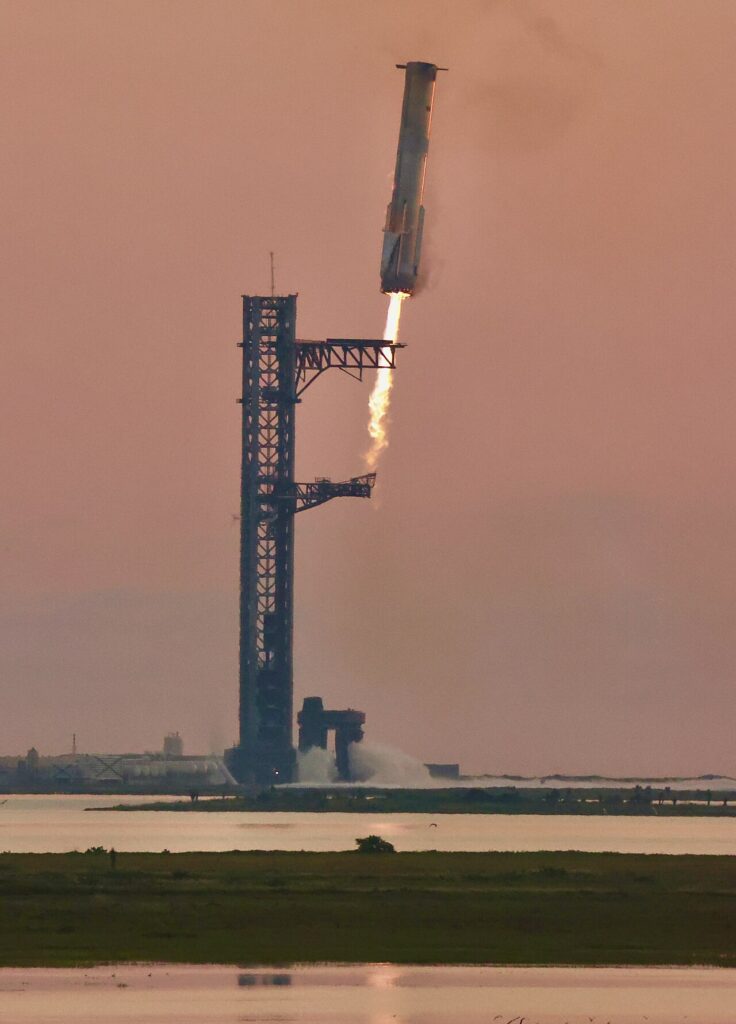
For years, rocket upper stages have had one fate: they burn up, sink or drift away as junk. On Saturday, November 14, 2026, SpaceX broke that rule. Its Starship spacecraft came home from 14 trips around Earth, flipped upright over the Texas coast and settled into the giant mechanical arms of the same tower it had launched from a day earlier. The SpaceX Starship catch is the first time any company has caught an upper stage returning from orbit.
Quick answer: On Starship Flight 15, SpaceX’s Ship 42 spent about 22 hours in orbit, deployed 26 Starlink V3 satellites and was then caught by the “Mechazilla” tower arms at Starbase, Texas, on November 14, 2026. It is the first catch of an upper stage returning from orbit. The Super Heavy booster’s own catch was aborted and it was lost in the Gulf of Mexico, so the full “double catch” did not happen.
What happened on Starship Flight 15
Starship lifted off from Pad 2 at Starbase at 4:47 p.m. Central Time on Friday, November 13 (22:47 UTC), according to Spaceflight Now. The mission was SpaceX’s most ambitious yet: catch both the Super Heavy booster and the Starship upper stage on the same flight, which would have made Starship the first fully recovered orbital rocket.
The booster part did not go to plan. About six and a half minutes after liftoff, Booster 22 cancelled its own catch. “In the later stages of the coast, the booster aborted itself for a GNC issue that it detected and that put it into its landing offshore,” SpaceX’s Dan Huot said on the webcast, as reported by Teslarati. The booster headed out over the Gulf of Mexico and exploded just above the water.
The ship, meanwhile, kept going. It reached orbit roughly 260 to 275 km (about 160 to 170 miles) up and released all 26 Starlink V3 satellites. Three of those satellites carried cameras to photograph Starship’s heat shield, and SpaceX said the images showed it was in good shape for reentry.
The catch itself
After about 14 orbits, Ship 42 fired an engine to leave orbit and plunged back into the atmosphere, slowing from roughly 17,000 mph. Reuters described the 171-foot vehicle dropping out of thick clouds over Starbase, relighting three engines to flip itself vertical and lowering itself into the tower’s “chopstick” arms with its engines still roaring. Charred from reentry, it shut down and hung still in the tower. Huot called the moment the “holy grail” of spaceflight, according to Reuters.
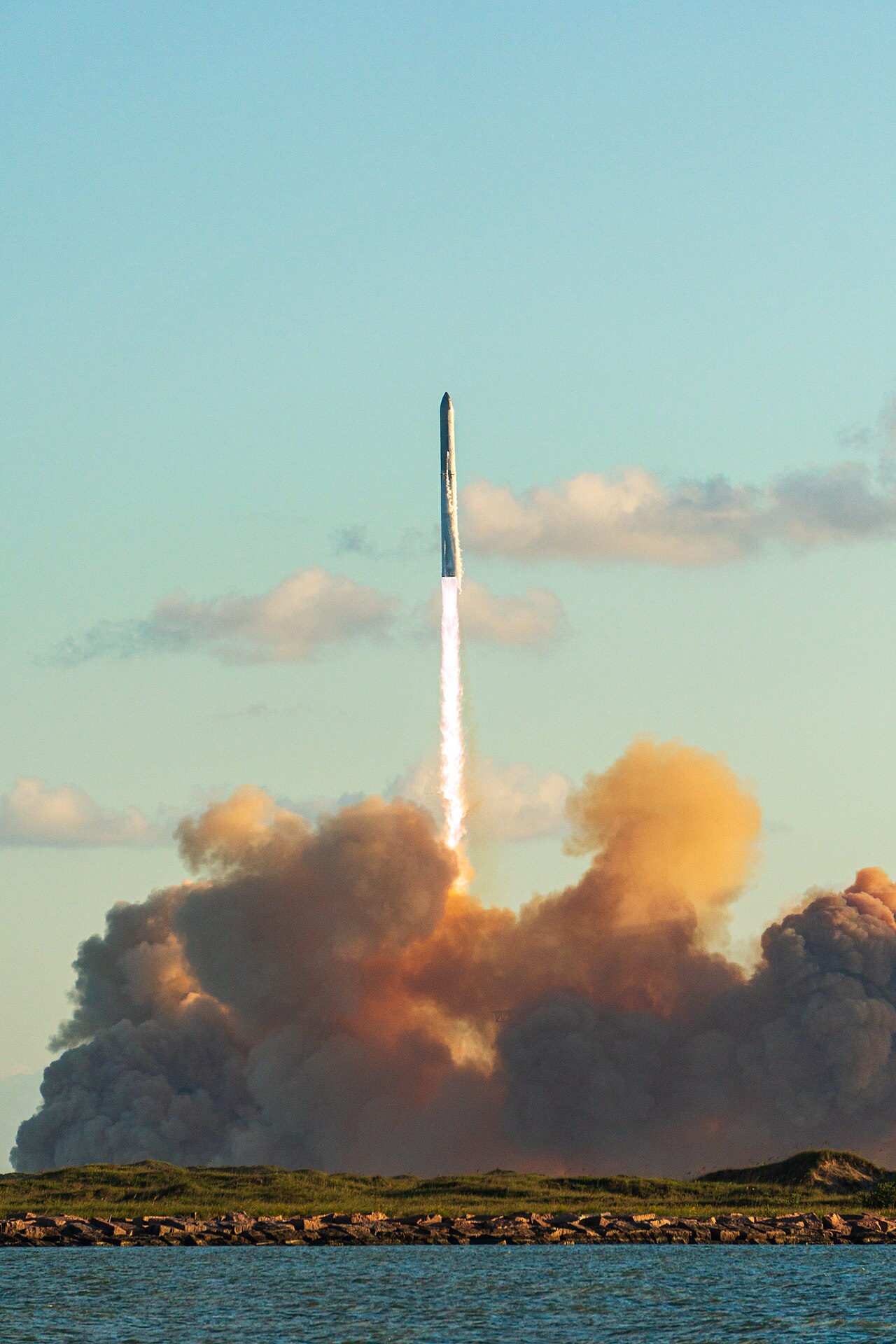
Starship Flight 15: key facts
| Detail | Flight 15 |
|---|---|
| Launch | Friday, November 13, 2026, 4:47 p.m. CT (22:47 UTC), Pad 2, Starbase, Texas |
| Vehicles | Super Heavy Booster 22 and Ship 42 (Version 3 / Block 3) |
| Payload | 26 Starlink V3 satellites, three with heat-shield inspection cameras |
| Time in orbit | About 22 to 22.5 hours, roughly 14 orbits |
| Ship height | 171 feet (52 m) |
| Ship result | Caught by the tower arms on Saturday, November 14: a world first |
| Booster result | Catch aborted by the guidance system; exploded offshore in the Gulf of Mexico |
Why the SpaceX Starship catch is such a big deal
SpaceX already lands rocket boosters routinely. Its Falcon 9 has flown more than 700 times since 2010, and its first stage comes back to be reused. But the second stage, the part that actually carries cargo into orbit, is thrown away every single time. That is a lot of expensive hardware lost on every flight.
Starship is designed so both halves come back and fly again, much like an airliner. The Super Heavy booster had already been caught by the tower three times before, most recently in March 2025, according to Teslarati. The ship was always the harder half: it has to survive reentry from orbital speed, then hit a tiny target with precision. Until Saturday, every Starship upper stage had ended up in the ocean or been lost.
For comparison, NASA’s Space Shuttle orbiter was reusable, but it glided to a runway and needed extensive refurbishment between flights, while its fuel tank was discarded. Catching the ship back on the launch tower is meant to allow a far quicker turnaround.
How it compares with earlier flights
| Flight | Date | What happened |
|---|---|---|
| Flight 5 | October 13, 2024 | First Super Heavy booster caught by the tower arms |
| Flight 14 | September 28, 2026 | Ship reached orbit for the first time; flight ended after about three hours with a Pacific splashdown |
| Flight 15 | November 13–14, 2026 | Ship caught after about 22 hours in orbit; booster lost |
What went wrong with the booster?
SpaceX says the booster’s guidance, navigation and control (GNC) system detected that the vehicle was not where it needed to be for a safe catch and automatically diverted it offshore. “It was doing what it was supposed to do,” Huot said, according to UPI. Elon Musk later wrote on X that the booster ran short of propellant because its engines slightly underperformed. His proposed fix is better engine consistency with the Raptor V3.2 engine and a software change to shut the engines down “about one second earlier.” He added that “this booster loss does not change our timeline to reach high volume, fully reusable Starship flights.”
The automatic abort matters for safety: a booster that is off-target must not come anywhere near the launch site or nearby homes. Version 3 of Super Heavy has yet to be caught successfully.
What’s next for Starship
Catching the ship is only half the job. Engineers now need to show that Ship 42 and the tower can be inspected, refurbished and flown again quickly. Reuters notes that Starship’s heat shield, made of black hexagonal tiles, is not yet fully reusable, and SpaceX is working on tile designs that need little or no repair between flights.
The stakes go well beyond SpaceX’s own satellites:
- Starlink: reusable ships make it cheaper to launch the larger Starlink V3 satellites at scale.
- NASA’s Artemis program: Starship is NASA’s lunar lander, and the plan relies on refuelling ships in orbit using several tanker flights. That only works if Starships can fly again and again. NASA is aiming to return astronauts to the lunar surface in 2028, UPI reported.
- Launch cadence: Musk has said he expects Starship to reach a weekly launch rate in the first half of 2027.
- Investors: SpaceX became a public company in 2026, and Morgan Stanley analyst Adam Jonas wrote before the flight that catching both stages would likely be “a material positive” for the stock, per Teslarati. This is not financial advice; do your own research before investing.
Musk-watchers have had a busy month; you can also read our explainer on why Tesla Cybertruck production is ending. And if this has you looking up, our guide to the Leonid meteor shower 2026 explains when to watch the sky this week.
Frequently asked questions
Did SpaceX catch Starship?
Yes. On November 14, 2026, SpaceX caught Ship 42, the Starship upper stage, with its launch tower’s mechanical arms after about 22 hours in orbit. It is the first time an upper stage returning from orbit has been caught.
Was the Super Heavy booster caught too?
No. The booster’s guidance system aborted the catch about six and a half minutes after liftoff and diverted it offshore, where it exploded over the Gulf of Mexico. That means Flight 15 did not achieve the full double catch.
How long was Starship in space on Flight 15?
About 22 to 22.5 hours, completing roughly 14 orbits. It is the longest Starship mission so far.
What is Mechazilla?
Mechazilla is the nickname for the launch tower at Starbase. Its two huge “chopstick” arms stack the rocket before launch and catch returning vehicles, setting them back on the launch mount for reuse.
Why does catching the upper stage matter?
Most rockets throw away their upper stage on every flight. Recovering it is the key step toward a fully reusable rocket, which SpaceX says will cut launch costs and make missions like NASA’s Moon landings and large Starlink deployments practical.
Sources: Reuters (via The Jerusalem Post), Teslarati, Spaceflight Now, Space.com, UPI, Wikipedia.