
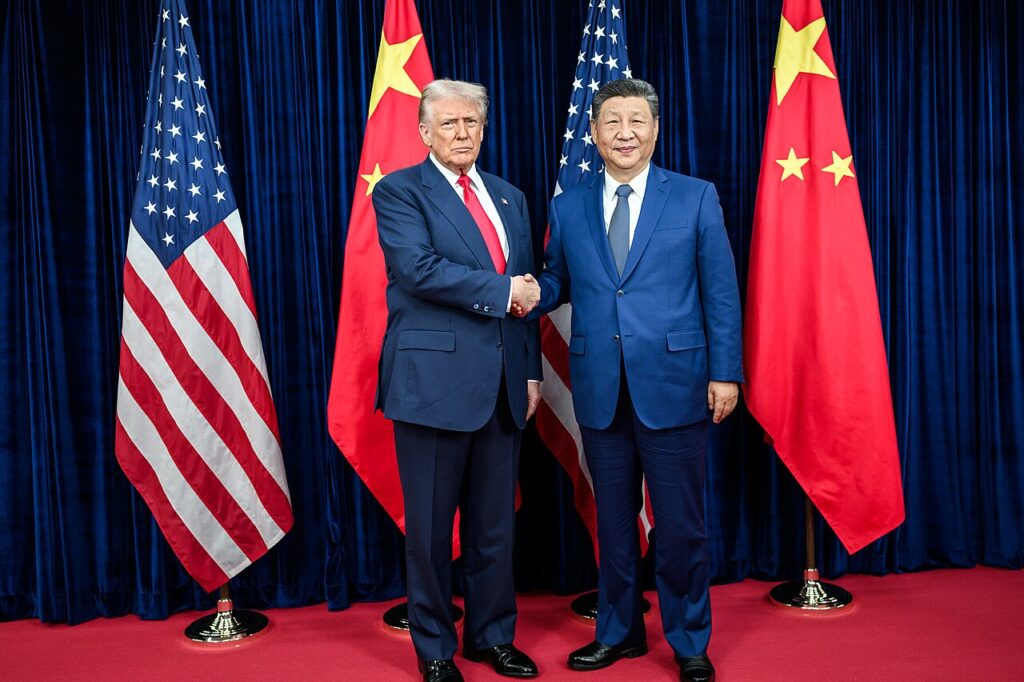
Donald Trump and Xi Jinping are meeting again, their fourth face-to-face summit of 2026, and this one comes with an unusual guest list. On Thursday, November 19, in the Chinese tech city of Shenzhen, the two leaders are expected to hold bilateral talks, and Xi will then host Trump and Russia’s Vladimir Putin for the first-ever three-way meeting between the leaders of the US, China and Russia. Just days before Trump arrives, Washington tightened its rules on AI chip exports, which puts technology right back at the centre of the Trump-Xi summit.
Quick answer: The Trump-Xi summit takes place on the sidelines of the APEC Economic Leaders’ Meeting in Shenzhen, China (November 18–19, 2026). Trump and Xi are expected to meet one-on-one on Thursday, November 19, and China has confirmed a trilateral meeting with Putin the same day. The White House says nuclear arms control is the main topic, alongside the Iran war, trade and AI safety. US officials have said they do not expect a formal agreement. New US curbs on AI chips, announced on November 16, are expected to hang over the talks.
What is happening this week
China is hosting the 33rd APEC Economic Leaders’ Meeting in Shenzhen on November 18 and 19, after an APEC CEO Summit on November 17–18. Leaders from the 21 APEC member economies are gathering in the city, which sits just north of Hong Kong and is home to many of China’s biggest technology companies.
Trump is reaching Shenzhen from Manila, where he is attending the ASEAN summit with Southeast Asian leaders. The White House confirmed on November 14 that he will attend APEC and take part in a trilateral meeting with Xi and Putin. On Monday, November 16, China formally confirmed that Xi will host that meeting on Thursday, November 19. The Kremlin has also said Trump and Putin will have their own one-on-one meeting.
Other leaders are already holding talks. Canadian Prime Minister Mark Carney met Xi in Shenzhen on November 17, and Japan’s Prime Minister Sanae Takaichi is scheduled to attend the summit as well.
Key facts at a glance
| Item | Details |
|---|---|
| Event | 33rd APEC Economic Leaders’ Meeting |
| Host city | Shenzhen, Guangdong province, China |
| Leaders’ meeting dates | November 18–19, 2026 |
| APEC CEO Summit | November 17–18, 2026 |
| Trump-Xi-Putin trilateral | Thursday, November 19 (confirmed by China) |
| Main US agenda item | A new nuclear arms control deal that includes China |
| Other topics | Iran war, trade, AI safety, chip export controls |
| Expected outcome | US officials say no formal agreement is expected |
Why the Trump-Xi summit is trending
Three things have pushed this meeting up the search charts in the US and around the world.
The three-way meeting is a first. The leaders of the US, China and Russia have never sat down together like this. A Russian lawmaker, Pyotr Tolstoy, has called it a possible “new Yalta”, a reference to the 1945 conference where Stalin, Roosevelt and Churchill shaped the post-war world. Kremlin spokesman Dmitry Peskov called the meeting “extremely significant” but said any agreements reached cannot be imposed on other countries.
The chip fight is back. On Monday, November 16, the US Commerce Department tightened export restrictions on advanced AI chips (more on that below). That landed only days before Trump sits down with Xi.
The Nvidia scandal. The talks come days after Nvidia co-founder Jensen Huang resigned as CEO following reports of an affair with a suspected Chinese spy. Beijing denies any spying. Huang had appeared at the Busan summit in 2025 to promote chip sales. We covered his exit in Jensen Huang Resigns as Nvidia CEO.
The new US chip curbs, explained
The Commerce Department’s new rule targets a loophole: Chinese companies renting powerful computing power instead of buying chips directly. According to reporting by CNN and Bloomberg, the rule:
- restricts US exports to data centres that provide “significant volumes” of computing to companies based in countries under US arms embargoes, such as China, Iran and Russia;
- aims to stop Chinese firms from renting Nvidia processors outside the US and from obtaining them through Singapore and several other countries;
- was, in Commerce’s own words, “written by and at the direction of the Department of Treasury and the National Security Council.”
It replaces a Biden-era export policy that the Trump administration let expire, arguing it was a burden on US businesses. Trump has acknowledged a split inside his team over the timing, saying Treasury Secretary Scott Bessent and Commerce Secretary Howard Lutnick “have two different views” on how fast Commerce should have acted.
Analysts quoted by Reuters expect Beijing to raise export controls. “President Xi may not name or mention Jensen Huang, but I’m pretty sure export controls will be high on the agenda when he meets Trump,” said George Chen of The Asia Group. Others think both sides want to keep the meeting calm. “Right now, I don’t think it’s in the interest of either side to let the potential export control squeeze sour the leaders’ summit,” said Bo Zhengyuan of research firm Plenum.
What’s on the agenda
1. Nuclear arms control
This is the White House’s headline topic. The New START treaty, which capped US and Russian strategic nuclear arsenals since 2010, lapsed in February. Trump turned down Russia’s offer to extend it and has asked for a “new, improved and modernised” deal that also includes China. White House spokesperson Olivia Wales told reporters that Trump “will discuss the reduction of nuclear weapons in the world.”
China has so far said no. Its Foreign Ministry said last month it would be “neither fair, reasonable nor realistic” to ask China to join trilateral nuclear disarmament talks at this stage. A senior US official told Reuters: “We do not expect to get to any kind of agreement,” describing the meeting as the start of a conversation.
2. The Iran war
Officials say the leaders will also discuss the war on Iran that the US and Israel launched on February 28. Full-scale strikes have paused, but the Strait of Hormuz remains closed and energy prices are volatile. That matters a great deal to China: about one-third of its crude oil passed through the strait before the war.
3. Trade and tariffs
The US-China trade truce is still fragile. In 2025, tariffs on each other’s goods climbed above 100% before Trump and Xi agreed to lower them at Busan. At their September summit in Washington, they agreed on a “Board of Trade” initiative to cut reciprocal tariffs on $30 billion worth of goods. A senior US official has said no further progress on that initiative will be announced this week.
4. AI safety
This is the one area where both sides seem to want a result. Bessent said both governments would discuss communication protocols for AI safety incidents at APEC and expected to share best practices for testing advanced AI models.
What about Ukraine?
A Trump administration official told reporters that Trump will not raise Russia’s war in Ukraine in Shenzhen, saying China “is not really a part of that track.” US envoys Steve Witkoff and Jared Kushner are running separate peace efforts with Kyiv and Moscow.
Background: four summits in one year
| Date | Meeting | Notable result |
|---|---|---|
| Oct 30, 2025 | Busan, South Korea (APEC) | First meeting of Trump’s second term; Trump said tariffs on Chinese goods would fall to 47% from 57% |
| May 13–15, 2026 | Trump state visit to Beijing | First of four Trump-Xi summits planned for 2026 |
| September 2026 | Xi state visit to Washington | Agreed “Board of Trade” tariff initiative and more AI dialogue |
| Nov 19, 2026 | Shenzhen (APEC) | Bilateral talks plus first trilateral with Putin |
| December 2026 | G20 summit, Miami | Xi scheduled to visit the US again |
What each side wants
The US wants China and Russia in a new nuclear treaty and a chance for Trump to lead talks among the major nuclear powers. Analysts note that last week’s midterm elections, which went badly for Republicans, could weaken his hand at home.
China wants to be seen at the centre of world diplomacy, to protect its energy supply by pushing for an end to the Iran conflict, and to avoid being pulled into a nuclear deal it did not help write. Chip controls are its biggest sore point.
Russia, analysts say, gets a high-profile stage alongside the US and China at a time when the Ukraine war is not on the table.
Views on what the meeting will achieve differ. Supporters of Trump’s approach say direct talks with rival leaders are the only way to start a new arms control framework. Critics argue it gives Russia a stage without progress on Ukraine. Simon Mabon of Lancaster University told Al Jazeera he expects “pretty impressive photo-ops” but doubts the three can end the conflicts in Iran or Ukraine.
What to watch next
- Beijing’s response to the chip rule. Bloomberg reports Xi must choose between hitting back now, which could threaten the trade truce, or waiting.
- Any AI safety announcement, such as an incident hotline, which would be the most likely concrete result.
- Market reaction. Chinese AI hardware stocks dipped on Monday, and chipmakers worldwide will be watching for any signal on export rules.
- A possible Trump-Kim meeting. Trump said he “may meet” North Korea’s Kim Jong Un in China.
- The December G20 in Miami, where Xi is due to meet Trump again.
Frequently asked questions
When is the Trump-Xi summit?
Trump and Xi are expected to meet on Thursday, November 19, 2026, on the sidelines of the APEC Economic Leaders’ Meeting in Shenzhen, China. The trilateral meeting with Putin is set for the same day.
Is Putin attending?
Yes. China and the White House have both confirmed a three-way meeting between Xi, Trump and Putin in Shenzhen. It is the first such meeting between the three leaders.
Will there be a trade deal?
Unlikely this week. A senior US official said no further progress on the $30 billion “Board of Trade” tariff initiative will be announced, and officials have said they do not expect any formal agreement from the trilateral talks.
What did the US change on AI chips?
On November 16, the Commerce Department restricted exports to data centres that supply large amounts of computing to companies in countries under US arms embargoes, including China. The goal is to stop Chinese firms renting advanced Nvidia chips abroad.
Why is the meeting compared to Yalta?
Because it brings the leaders of three major powers together to discuss global security, as the US, Britain and the Soviet Union did at Yalta in 1945. The Kremlin has played down the comparison.
For more on the chip fight, read our earlier report on the Nvidia board investigation into Jensen Huang.
Sources: Al Jazeera, Reuters (via BusinessWorld and Asharq Al-Awsat), CNN, NBC News, Bloomberg, Outlook India, Wikipedia (APEC China 2026, Busan Summit).