
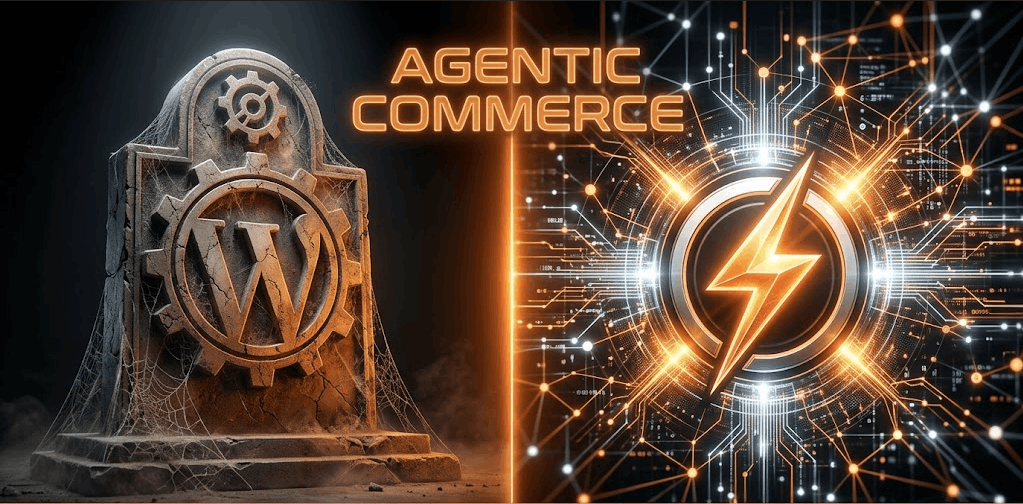
The shift toward the “Agentic Web” represents a fundamental change in how e-commerce operates. In this new landscape, transactions are increasingly managed by AI shopping agents—intelligent software that autonomously navigates the web to find, compare, and execute purchases on behalf of users.
For modern e-commerce stores, this evolution necessitates a move away from traditional, monolithic architectures toward headless, data-centric systems.
What is the Agentic Web?
Unlike human shoppers who browse visual storefronts, AI shopping agents interact with “machine-readable” interfaces.
- Goal-Oriented Discovery: Instead of browsing categories, agents are given specific constraints—such as “find a tent under $150 delivered by Friday”—and they evaluate multiple retailers in real time to fulfill these goals.
- Autonomous Execution: These agents can plan multi-step workflows, call external APIs, and even complete transactions using delegated authentication systems, like Google’s Agent Payments Protocol or Stripe’s instant checkout.
Why Headless Architecture is Essential
Traditional commerce platforms often “silo” product information within a coupled, theme-heavy frontend that is difficult for AI to parse. A headless architecture is superior for the agentic era because it decouples the presentation layer from the business logic.
- API-First Accessibility: By exposing product catalogs, pricing, and availability through structured APIs, you allow AI agents to validate inventory and perform “agent-to-agent” negotiations directly with your store.
- Agility & Performance: Headless stores are significantly faster, a key factor since AI agents prioritize high-speed responses for discovery.
- Omnichannel Readiness: A headless approach allows you to push structured content to any digital touchpoint—whether it’s a web store, a mobile app, or an AI shopping assistant—without needing to rebuild your backend.
Preparing Your Store for AI Agents
To remain visible in this AI-driven ecosystem, your data must move from “human-readable” to “machine-readable”.
- Implement Structured Data (Schema.org): Use schema markup to provide clear, well-defined data about your products, including material, color, and compatibility. This allows AI systems to accurately compare your offerings against competitors.
- Expose Clean API Feeds: Provide product data feeds (CSV, XML, or JSON) that are updated in real time. This continuous flow of precise information is crucial for AI models to learn effectively and make accurate predictions.
- Optimize for “Agentic SEO”: Move beyond standard keywords. Structure your content so that LLMs can easily extract relevant features, use cases, and benefit-driven descriptions.
- Standardize Attributes: Use uniform identifiers (e.g., “Color,” “Size,” “Material”) across your entire catalog to make it easier for agents to filter and sort your products alongside those of other retailers.
By shifting your technical strategy today, you ensure that your store doesn’t just exist for human visitors, but is also “discoverable” and “purchasable” by the growing population of AI-driven shopping agents.