
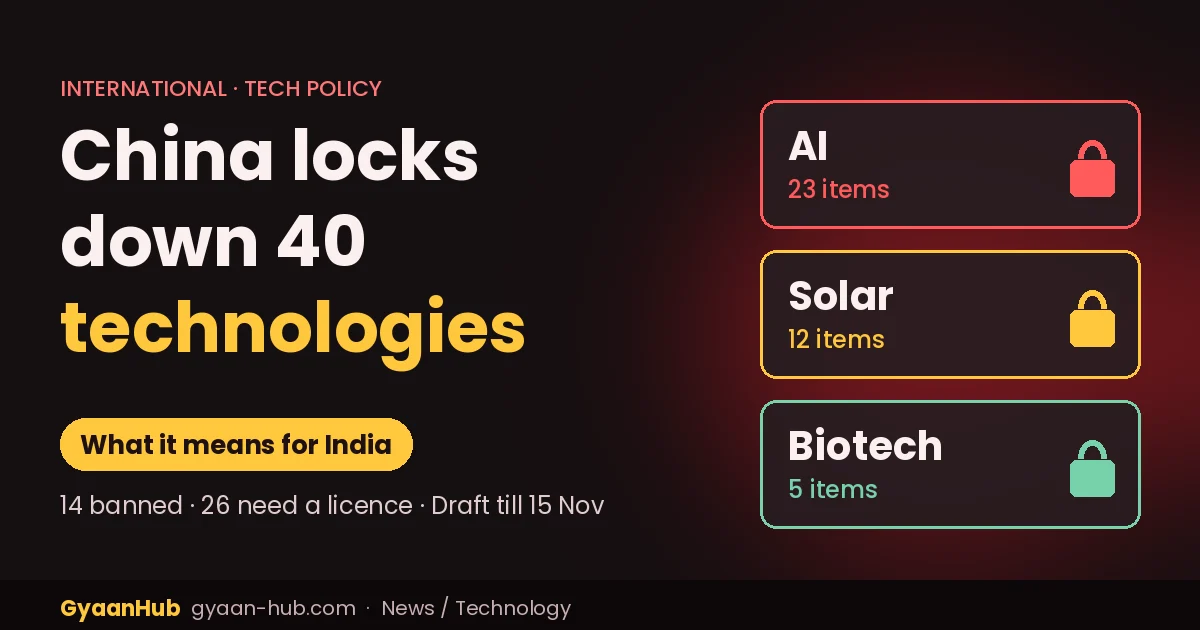
Quick answer: on 16 October 2026, China published a draft list of 40 technologies it wants to control for export: 14 would be banned outright and 26 would need a government licence. The list covers AI (23 items), solar (12) and biotech (5). Comments close on 15 November. For India, the biggest risk is to solar manufacturing, which still depends on Chinese machines and know-how.
Here is what the draft covers, what it leaves out, and why it matters for India.
What China announced
China’s Ministry of Commerce and Ministry of Science and Technology jointly released the draft revision, known as Announcement No. 48. A pre-export registration requirement took effect the same day, while the full list is open for public comment until 15 November 2026.
| Sector | Items | Examples |
|---|---|---|
| Artificial intelligence | 23 | Large-model technology, AI agents, compute-cluster orchestration, advanced AI chip design including 2.5D/3D packaging |
| Solar (photovoltaics) | 12 | Perovskite and tandem cell production (banned), large polysilicon lines, ingot casting, wafer slicing |
| Biomedicine | 5 | Proprietary cell and gene therapy platforms |
| Total | 40 | 14 prohibited, 26 restricted |
The AI rules: what is controlled and what is not
The AI section draws a careful line between using a Chinese model and taking the technology abroad:
- Outside the controls: using a model through an API, an app, a website or a SaaS product, and lightweight on-device versions.
- Controlled: deploying restricted models locally on servers abroad, or transferring model weights and source code above performance thresholds.
- Banned: technology that uses AI to generate and mutate malicious code.
- Restricted: AI tools that discover software vulnerabilities.
- Open source: technology already public through open-source releases or research papers is excluded.
In practice, Indian developers using Chinese open-weight models already published online should not be affected. Companies hoping to license or self-host newer, more powerful Chinese models abroad may face a licence process.
Why China is doing this
- Protecting its lead in solar: China controls the large majority of the world’s polysilicon and wafer production and wants to keep its newest manufacturing know-how at home.
- Answering Western curbs: Beijing says the rewrite brings it in line with export controls other major economies already use, after years of US restrictions on chips sold to China.
- Security concerns: some items, like AI-generated malware, are framed as cyber threats.
What it means for India
1. Solar manufacturing could slow down
India is building its own solar supply chain under the PLI scheme, including big ingot and wafer plants. Many of these depend on Chinese ingot pullers, wire saws and engineers to install them. If licences are refused or delayed, timelines could slip and costs could rise. Indian makers may also stay on today’s TOPCon and PERC cells and miss the next jump to perovskite-tandem panels.
2. Joint ventures get harder
Deals that transfer Chinese technology to Indian partners, a route India had begun easing, would now need Chinese export registration. Some may stall.
3. AI: limited direct impact, but a signal
India’s AI work relies more on US and open-source models than Chinese ones, and API access stays open. The bigger message is that AI is becoming a strategic, controlled technology on both sides, which strengthens the case for India’s own models built on IndiaAI compute.
4. Biotech supply chains
Access to some licensed gene-therapy platforms and inputs could become slower, which may affect certain research and trials.
What happens next
This is still a draft. After the 15 November comment deadline, China can change the list before it takes effect. Indian companies with Chinese technology deals in the pipeline should check whether their projects fall under the listed items now, and look at alternative suppliers in Japan, Europe and the US where possible.
We have seen how global supply shocks hit Indian wallets before: read our explainer on the 2026 Strait of Hormuz oil crisis.
Frequently asked questions
When did China announce the technology export curbs?
On 16 October 2026, through the Ministry of Commerce and the Ministry of Science and Technology.
How many technologies are on China’s list?
40 in total: 23 in AI, 12 in solar and 5 in biomedicine. Of these, 14 would be banned and 26 restricted.
Can Indians still use Chinese AI models?
Yes. Using models through APIs, apps or websites is outside the controls, and already-published open-source models are excluded.
Will solar panels get more expensive in India?
Finished products are not covered, but if Indian factories struggle to get Chinese equipment and know-how, domestic manufacturing costs could rise over time.
Is the rule final?
No. It is a draft open for comments until 15 November 2026.
Sources: Dealroom; Xenospectrum; InsightsOnIndia; Legacy IAS. Item counts and thresholds may change in the final version.