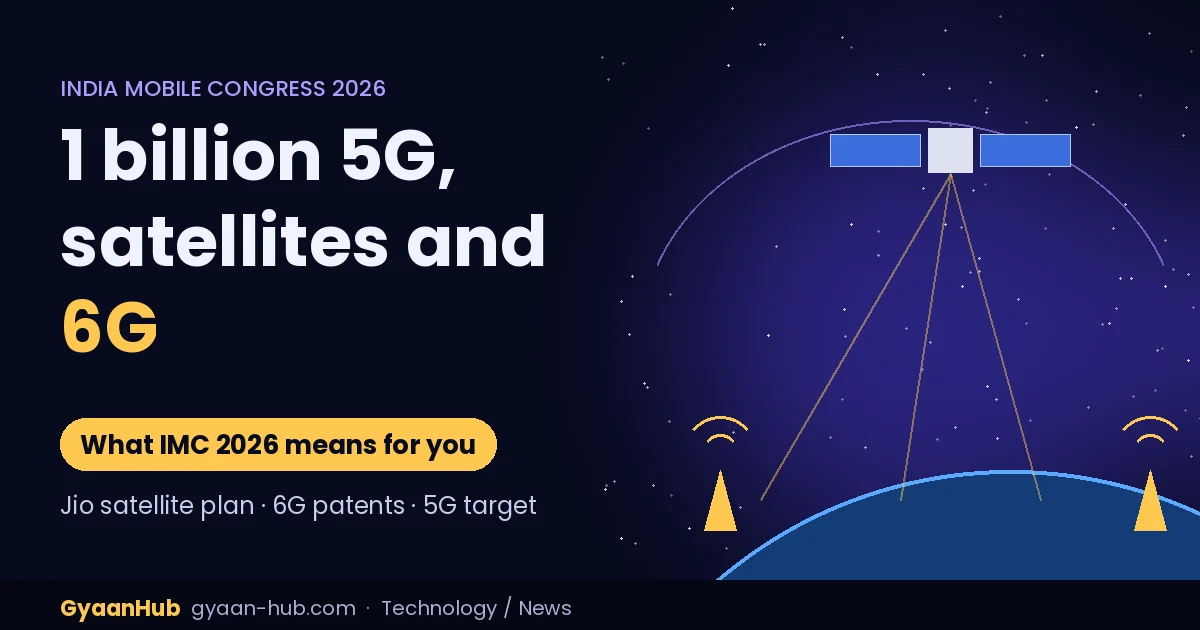
Quick answer: India Mobile Congress 2026, the 10th edition of Asia’s biggest telecom event, set out where India’s internet is heading. The big takeaways: a target of 1 billion 5G users by 2030, Jio’s plan for a home-grown satellite network covering 6 lakh villages, early 6G research, and India winning the right to host the ITU’s top conference in 2030.
Here is what was announced, and what it means for your phone and internet over the next few years.
IMC 2026 in numbers
| Edition | 10th |
| Theme | Scale Without Boundaries |
| Where | New Delhi, four days, inaugurated by PM Narendra Modi |
| Visitors | Over 1.5 lakh from 100+ countries |
| Exhibitors and startups | 600+ partners, 500+ startups |
| Use cases shown | 2,000+ |
1. One billion 5G users by 2030
Communications Minister Jyotiraditya Scindia said India wants to nearly double its 5G users, from about 550 million today to one billion by 2030. The focus is now on reaching rural and underserved areas, sharing infrastructure between operators, and making the last mile cheaper.
What it means for you: more 5G coverage outside big cities, and growing pressure on operators to move users from 4G to 5G plans.
2. Jio’s own satellite network
The headline business announcement came from Reliance Jio. Chairman Akash Ambani said Jio is building a home-grown satellite technology stack and has filed early patents in the “pre-6G” space. Jio wants India to hold 10% of the world’s 6G patents.
- Jio’s proposed plan includes about 1,600 low-earth-orbit satellites and 23 ground stations in India.
- The aim is to connect more than 6 lakh villages, plus islands, border posts and ships at sea.
- It includes direct-to-device service, where an ordinary phone connects straight to a satellite with no tower in between.
- Jio wants the full chain, from design to operations, to stay in India under the banner “Sovereign Satellite Connectivity”.
This is still a proposed plan. It needs spectrum, approvals and launches before it reaches users.
3. Satellite internet competition heats up
Starlink said it has set up more than 20 gateway sites in India. With Jio, Starlink and others preparing services, the event’s sessions also discussed the groundwork for a satcom policy and how satellite and mobile networks will work together.
What it means for you: in a few years, people in remote areas may get usable internet without fibre or a nearby tower, and phones may fall back to satellite when there is no signal.
4. 6G: research, not launch
The 3rd International Bharat 6G Symposium was formally opened at IMC, with a focus on testbeds and deep-tech startups. 6G is still years away from phones; the work now is on standards and patents, where India wants a bigger share than it had with 4G and 5G.
5. “Own the technology”
PM Modi’s message was that India has moved from using technology to creating it. He urged companies to own core intellectual property, design products in India, and build an Indian semiconductor industry.
Other launches from the operators
- Airtel: announced free international roaming with all postpaid plans.
- BSNL: showed an upgrade to its Vaani platform, AI-based security and Bharat Sandesh.
- Vodafone Idea: showcased AI-powered services and connectivity solutions.
- Ericsson: is scaling up manufacturing of AI-ready antennas in India.
India to host the ITU’s 2030 summit
The International Telecommunication Union Council accepted India’s bid to host the ITU Plenipotentiary Conference in 2030, the UN telecom agency’s top-level meeting. That gives India a bigger voice in setting global rules for networks, spectrum and future technologies like 6G.
Frequently asked questions
What is India Mobile Congress?
Asia’s largest digital technology event, organised by the Department of Telecommunications and the Cellular Operators Association of India (COAI). 2026 was its 10th edition.
When will 6G launch in India?
There is no launch date. 6G is in the research and standards stage, with commercial networks expected around the end of the decade.
What is direct-to-device satellite service?
A service that lets a normal smartphone connect directly to a satellite, without a mobile tower, for calls, messages or data in areas with no coverage.
Is Jio’s satellite network live?
No. Jio presented a proposed constellation of about 1,600 satellites; it still needs approvals and launches.
What is India’s 5G target?
One billion 5G users by 2030, up from about 550 million.
Sources: TimesTech; MediaBrief; TelecomTalk; NewsBytes.