Quick answer: on 17 October 2026, DeepSeek released V4.1-Flash-1017, an updated version of its fast, low-cost AI model. In DeepSeek’s own benchmarks it beats its previous version on every test and tops several coding-agent benchmarks, while API prices stay at just $0.30 per million input tokens. It also launched new Search and Fetch APIs for AI agents.
Here is what changed, how it compares, and how developers can use it.
DeepSeek V4.1-Flash-1017 at a glance
| Released | 17 October 2026 |
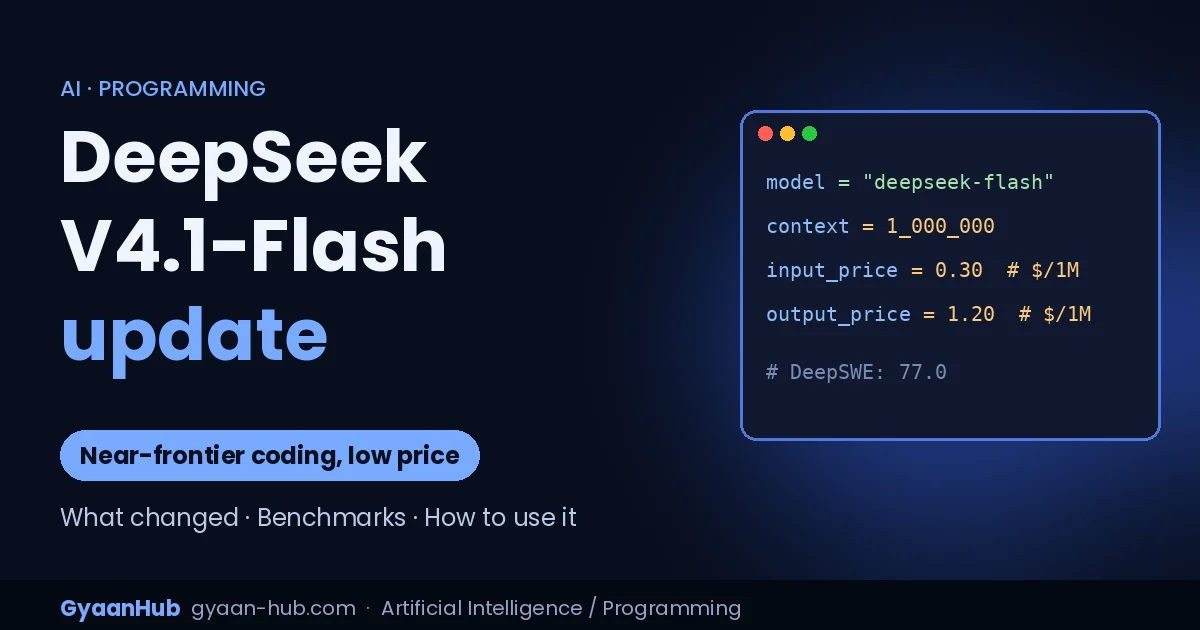
| API model name | deepseek-flash |
| Architecture | Mixture-of-Experts, 552B backbone parameters, about 8B active per token in prefill and 16B in decode |
| Context window | 1 million tokens, up to 384K output |
| Price (peak) | $0.30 per 1M input tokens, $1.20 per 1M output tokens |
| Price (off-peak) | Half the peak rate |
| Open weights | The September V4.1-Flash base is MIT-licensed on Hugging Face |
“Active parameters” matters because only a small slice of the model runs for each token. That is why such a large model can be so cheap and fast.
Benchmarks: where it leads and where it doesn’t
| Benchmark | V4.1-Flash-1017 | Previous V4.1-Flash | Best rival listed |
|---|---|---|---|
| DeepSWE v1.1 (coding agent) | 77.0 | 74.2 | 74.0 (Claude Opus 5) |
| Automation-Bench | 60.5 | 54.8 | 50.3 (Claude Opus 5) |
| Terminal-Bench 4.0 | 42.3 | 31.2 | 51.8 (Claude Opus 5) |
| Humanity’s Last Exam (no tools) | 42.6 | 36.8 | 56.3 (Claude Opus 5) |
These are DeepSeek’s own figures, and the comparison uses older rival models rather than the newest releases from this month. The honest summary: it is not the smartest model available, but it delivers near-frontier coding-agent results at a small fraction of the cost.
New: Search and Fetch APIs
DeepSeek also opened two tools that AI agents can call directly:
- Search returns 1 to 50 ranked web results per query, with filters like
site:,lang:,after:andbefore:. - Fetch returns a single web page converted to Markdown, ready for an AI to read.
- Price: $0.75 per 1,000 successful requests each. Empty results and failures are free. Calls made through supported coding agents are free until 1 November 2026.
How developers can use it
- Create an API key on DeepSeek’s platform.
- Call the model
deepseek-flashthrough DeepSeek’s endpoint. It supports both the OpenAI-style and Anthropic-style API formats, so most existing code and tools need only a base URL and model name change. - Run heavy batch jobs during off-peak hours to pay half price.
Self-hosting the full model needs a multi-GPU server with high-memory cards, so for most individual developers and small teams, the API is the practical route.
Should you switch?
- Good fit: high-volume tasks, coding assistants, automation scripts, and agent workflows where cost matters more than the last few points of accuracy.
- Think twice: sensitive business or customer data. DeepSeek is a Chinese company, so review its data policies and your own compliance requirements before sending private data. Self-hosting the open weights avoids that issue but costs much more to run.
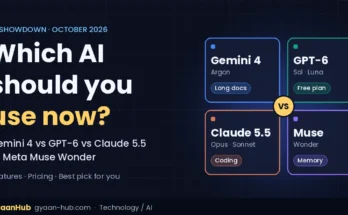
For a comparison of the big Western models launched this month, see Gemini 4 vs GPT-6 vs Claude 5.5 vs Muse Wonder.
Frequently asked questions
What is DeepSeek V4.1-Flash-1017?
An updated checkpoint of DeepSeek’s fast V4.1-Flash model, released on 17 October 2026, with better coding and agent performance at the same low price.
How much does the DeepSeek API cost?
$0.30 per million input tokens and $1.20 per million output tokens at peak times, and half that off-peak.
Is DeepSeek open source?
The September V4.1-Flash weights are published under the MIT licence. DeepSeek hasn’t separately stated the licence for the 1017 checkpoint.
Is DeepSeek better than Claude or GPT?
On some coding-agent benchmarks it scores higher than older rival models; on reasoning and terminal tasks, top models still lead. Its main advantage is price.
Sources: MarkTechPost; AI Weekly; Techmeme coverage (Bloomberg, The Decoder). Benchmarks are as reported by DeepSeek.