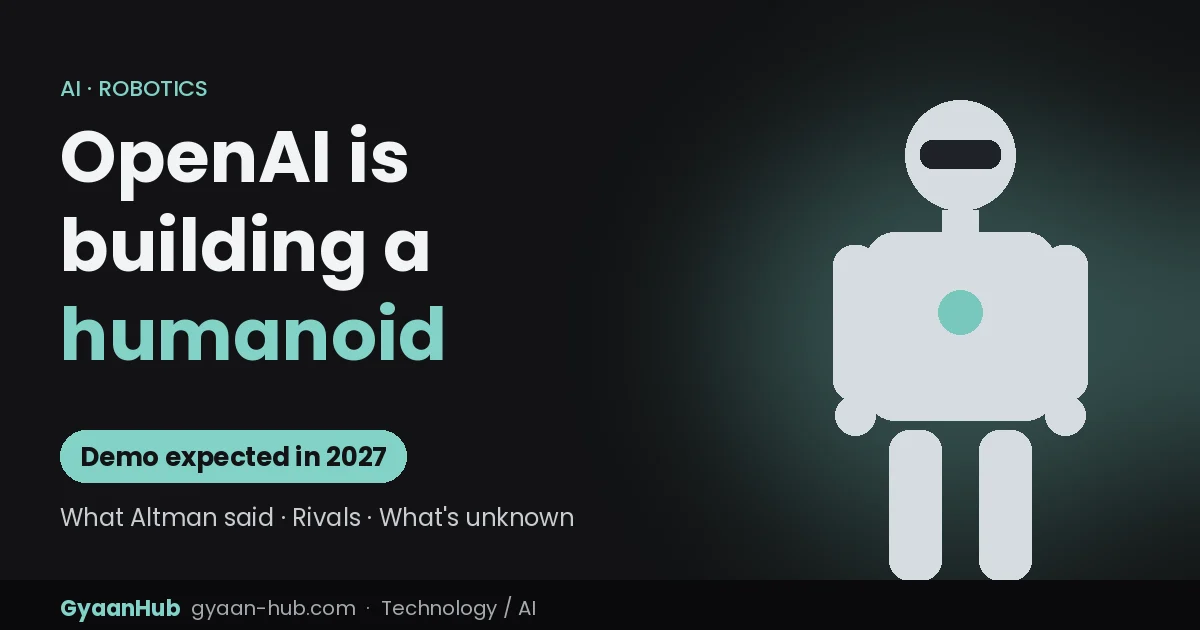
Quick answer: OpenAI is building its own humanoid robot. CEO Sam Altman confirmed it on OpenAI’s Sources podcast, simply saying “We will” when asked, and he has said he expects “a cool demo in 2027”. OpenAI is already hiring for dozens of robotics roles, but there is no robot, price or release date yet.
Here is what we know, why OpenAI wants a body for its AI, and how it stacks up against Tesla and others.
What Sam Altman said
- Asked on OpenAI’s Sources podcast whether OpenAI would build a humanoid, Altman answered: “We will.”
- He argued a human shape makes sense because “the world is very much designed for people”: doors, stairs, tools and kitchens are all built for human bodies.
- He said the robot’s “brain”, the AI controlling it, matters more than the physical design.
- In a separate Fortune interview in September, he said: “I think we’ll have a cool demo in 2027,” adding that robots walking city streets are a few years further out.
What OpenAI is building
OpenAI’s careers page lists 27 robotics roles. The job posts give a clear picture of the plan:
- Control and movement: motion control, state estimation, actuator control and whole-robot behaviour.
- Custom hardware: OpenAI is designing its own electromechanical actuators, the motors, gears and sensors that move a robot’s joints.
- Manufacturing: roles in manufacturing and supply chain suggest it plans to produce robots, not just research them.
- Goals: in the short term, general-purpose robots that help skilled workers build infrastructure; in the long term, a personal robot that can handle a wide range of everyday tasks.
OpenAI has done robotics before
This isn’t OpenAI’s first robotics project. Years ago, its Dactyl project trained a robotic hand entirely in simulation and later used it to solve a Rubik’s Cube. OpenAI shut down that team to focus on language models. Now, with far more capable AI models, it is returning to physical robots.
The competition
| Company | Robot | Status |
|---|---|---|
| Tesla | Optimus | In development for several years |
| XPENG | IRON | Recently rolled off its production line |
| OpenAI | Not yet named | Demo expected in 2027 |
OpenAI starts behind on hardware, but its bet is that the hardest part of a useful robot is the intelligence, which is where it is strongest.
What is still unknown
- What the robot will look like or what the 2027 demo will show.
- Price, release date, or whether it will be sold or rented as a subscription.
- How it will handle privacy, given that a home robot would see and hear everything around it.
Why it matters
AI is moving from screens into the physical world. Chatbots answer questions; agents complete tasks online; robots would complete tasks in your home or workplace. If OpenAI’s models can reliably control a body, it could reshape construction, warehouses, manufacturing and eventually household work. It also raises big questions about jobs and safety that governments, including India’s, will need to plan for.
Frequently asked questions
Is OpenAI making a humanoid robot?
Yes. Sam Altman confirmed OpenAI will build a humanoid robot.
When will OpenAI’s robot be released?
There is no release date. Altman expects a demo in 2027 and says wider real-world use is a few years after that.
How much will the OpenAI robot cost?
OpenAI hasn’t announced a price or business model.
Who are OpenAI’s competitors in humanoid robots?
Tesla with Optimus and XPENG with IRON are among the best known.
Sources: Engadget; Fortune; AI Weekly; OpenAI careers page as reported.