
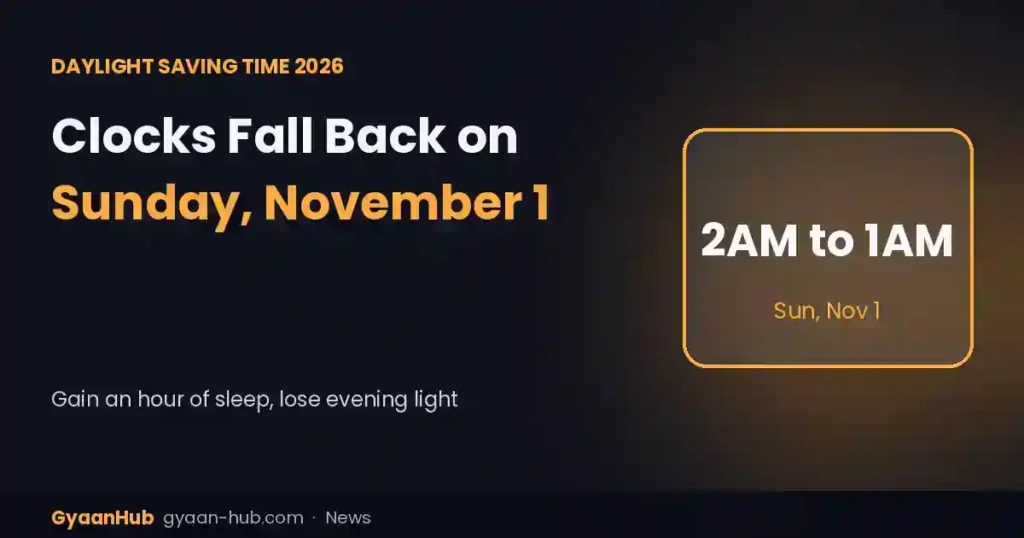
Tonight is the night most Americans get an extra hour of sleep, and lose an hour of evening daylight in return. Daylight saving time ends early on Sunday, November 1, 2026, and searches for “when do clocks fall back” and “daylight saving time ends” are climbing across the US and Canada. This year the switch comes with a twist: the House has already voted to make daylight saving time permanent, so many people are asking whether this could be one of the last times they change their clocks. Here is exactly what happens, when, and where the law stands.
Quick answer: Daylight saving time ends at 2:00 a.m. local time on Sunday, November 1, 2026. Clocks go back one hour to 1:00 a.m., so you gain an hour of sleep. Phones and computers update automatically, but set manual clocks (car, oven, microwave, wall clocks) back before bed on Saturday, October 31. Sunrise and sunset will both come about an hour earlier on the clock. Hawaii and most of Arizona do not change. Clocks spring forward again on Sunday, March 14, 2027, unless Congress changes the law first.
When exactly do the clocks change?
Under the Uniform Time Act of 1966, daylight saving time (DST) in the US runs from the second Sunday in March to the first Sunday in November. In 2026, that first Sunday is November 1. At 2:00 a.m. local time, the clock goes back to 1:00 a.m., which means the hour between 1:00 and 2:00 a.m. happens twice.
Because the change happens at 2:00 a.m. local time, it does not happen everywhere at once. It moves across the country time zone by time zone, starting on the East Coast and ending in Alaska.
What you need to do before bed
- Smartphones, computers, smartwatches and most smart home devices update on their own, as long as automatic time is switched on.
- Manual clocks such as car dashboards, ovens, microwaves, older alarm clocks and wall clocks need to be set back one hour by hand.
- Medication and work shifts: If you take medicine at a set time or work an overnight shift, check how your schedule handles the repeated hour.
- Safety checks: Many fire departments use the twice-yearly clock change as a reminder to test smoke and carbon monoxide alarms.
Key facts at a glance
| Question | Answer |
|---|---|
| Date DST ends in 2026 | Sunday, November 1, 2026 |
| Time of the change | 2:00 a.m. local time (clocks go back to 1:00 a.m.) |
| Extra sleep? | Yes, one hour |
| US places that do not change | Hawaii, most of Arizona, Puerto Rico, US Virgin Islands, Guam, American Samoa, Northern Mariana Islands |
| Exception inside Arizona | The Navajo Nation does observe DST |
| DST starts again | Sunday, March 14, 2027, at 2:00 a.m. (clocks go forward to 3:00 a.m.) |
| DST would end again | Sunday, November 7, 2027, under current law |
| Federal law | Uniform Time Act of 1966 |
How much earlier will it get dark?
The clock change does not create or remove daylight. It shifts it. Once standard time returns, both sunrise and sunset happen about an hour earlier on the clock. Mornings get brighter for commuters and school children, and evenings get dark noticeably sooner.
Here are approximate sunrise and sunset times for a few major US cities on Saturday and Sunday this weekend:
| City | Sunrise Oct 31 | Sunset Oct 31 | Sunrise Nov 1 | Sunset Nov 1 |
|---|---|---|---|---|
| New York | 7:25 a.m. | 5:53 p.m. | 6:26 a.m. | 4:51 p.m. |
| Chicago | 7:22 a.m. | 5:45 p.m. | 6:23 a.m. | 4:44 p.m. |
| Denver | 7:27 a.m. | 5:58 p.m. | 6:28 a.m. | 4:57 p.m. |
| Los Angeles | 7:12 a.m. | 6:00 p.m. | 6:12 a.m. | 4:59 p.m. |
| Miami | 7:28 a.m. | 6:39 p.m. | 6:29 a.m. | 5:38 p.m. |
Times are approximate, calculated from each city’s coordinates, and can differ by a minute or two from local almanacs.
In other words, New York goes from a sunset just before 6 p.m. on Halloween to one before 5 p.m. the next day. Sunsets keep getting earlier until early December, when the shortest days arrive in the run-up to the winter solstice.
Why it is trending this year
The clock change trends every autumn, but 2026 has added interest for three reasons.
- It falls on Halloween night. The switch happens in the early hours after trick-or-treating, so families are planning around a late night and an extra hour.
- The House voted to end the switch. On July 14, 2026, the House of Representatives passed the Sunshine Protection Act (H.R. 139), which would make daylight saving time permanent. ABC7 reported the vote was 308 to 117.
- Canada changes the same night. Most of Canada also falls back on November 1, and searches for “changement d’heure” are among the top trends in Canada this weekend.
Is this the last time clocks fall back? Where the Sunshine Protection Act stands
Not yet, and probably not this year. Passing the House was a big step, but a bill has to pass both chambers and be signed by the president to become law.
The House bill was sponsored by Rep. Vern Buchanan of Florida, who has pushed the idea for years. “I urge the Senate to send this long-overdue reform to the president’s desk,” Buchanan said after the vote, according to the House Energy and Commerce Committee. Rep. Gus Bilirakis, who chairs the relevant subcommittee, put it more simply: “Americans are ready to ditch the switch.”
After the vote, the bill went to the Senate on July 15 and was referred to the Senate Commerce, Science, and Transportation Committee. As of late October, it had not received a Senate vote. ABC7 reported that it has stalled there, with opponents arguing it needs more debate. The Washington Post described the House bill as President Trump’s plan, and Trump has publicly backed ending the twice-yearly change, but White House support alone does not move a bill through the Senate.
This has happened before. In March 2022, the Senate passed an earlier version of the Sunshine Protection Act by unanimous consent, but the House never voted on it and the bill died when that Congress ended. This time the order is reversed.
Permanent daylight time vs permanent standard time
Almost everyone agrees on ending the switch. The fight is over which time to keep.
- Permanent daylight saving time (what the bill proposes) would keep lighter evenings all year. Supporters point to more after-work daylight for shopping, sport and tourism. The trade-off is very dark winter mornings. A 7:20 a.m. winter sunrise would become about 8:20 a.m.
- Permanent standard time is favoured by many sleep and health groups, including the American Academy of Sleep Medicine, which says standard time lines up better with the body clock and the sun.
Under current federal law, states can choose to stay on standard time all year (as Hawaii and most of Arizona do), but they cannot adopt permanent daylight saving time on their own. That is why many states have passed “trigger” laws that would only take effect if Congress allows it.
A short history of the clock change
The US first used daylight saving time during World War I and again in World War II as an energy-saving measure. For decades afterwards, the rules varied by state and city, which caused confusion for transport and broadcasting. The Uniform Time Act of 1966 created a single national framework.
The US has also tried year-round daylight time before. During the 1970s energy crisis, Congress put much of the country on permanent DST starting in January 1974. It proved unpopular, partly because of children going to school in the dark, and Congress restored standard time in October 1974, earlier than planned. Energy prices are again in the headlines this year, as we explained in our look at ExxonMobil’s record refining profits, but no one in Congress is arguing for a clock change on energy grounds this time.
The current start and end dates (second Sunday in March, first Sunday in November) have applied since 2007, after the Energy Policy Act of 2005 extended daylight saving time by several weeks.
What the change means for international time differences
If you work with people abroad, the gap with some countries shifts this weekend.
- UK and Europe: Clocks there went back a week earlier, on October 25. For the past week, New York has been four hours behind London instead of five. From Sunday the usual five-hour gap returns.
- India: India does not use daylight saving time. From November 1, US Eastern time is 10 hours 30 minutes behind India Standard Time, up from 9 hours 30 minutes.
- Australia: States that use daylight saving, such as New South Wales and Victoria, moved their clocks forward in early October, so the gap with the US grows again this weekend.
What’s next
- Sunday, November 1: Clocks fall back at 2:00 a.m. Expect a few groggy days as your body adjusts.
- Tuesday, November 3: Election Day for the US midterms. Polls open on standard time, so double-check opening hours if you vote early in the morning.
- December 21: The winter solstice, the shortest day of the year in the Northern Hemisphere.
- Sunday, March 14, 2027: Clocks spring forward again, unless the Senate passes and the president signs the Sunshine Protection Act before then.
Note: Sleep changes can affect people differently. This article is general information and not medical advice. If you have a sleep disorder or take time-sensitive medication, ask your doctor how to handle the clock change.
Frequently asked questions
Do we gain or lose an hour on November 1, 2026?
You gain an hour. At 2:00 a.m. on Sunday, clocks go back to 1:00 a.m., so the night is one hour longer.
Will my phone change automatically?
Yes. iPhones, Android phones, computers and most smart devices update automatically if automatic date and time is turned on. Car clocks, ovens, microwaves and wall clocks usually need to be changed by hand.
Which states don’t change their clocks?
Hawaii and most of Arizona stay on standard time year-round. The Navajo Nation in Arizona does observe daylight saving time. Puerto Rico, the US Virgin Islands, Guam, American Samoa and the Northern Mariana Islands also do not change.
Is daylight saving time becoming permanent?
Not yet. The House passed the Sunshine Protection Act on July 14, 2026, but the Senate has not voted on it. Until both chambers pass it and the president signs it, the twice-yearly change continues.
When do clocks spring forward in 2027?
Under current law, daylight saving time begins again on Sunday, March 14, 2027, at 2:00 a.m., when clocks move forward to 3:00 a.m.
Sources: FOX 5 DC, ABC7, Farmers’ Almanac, House Energy and Commerce Committee, The Washington Post, Wikipedia (Sunshine Protection Act), Google Trends.