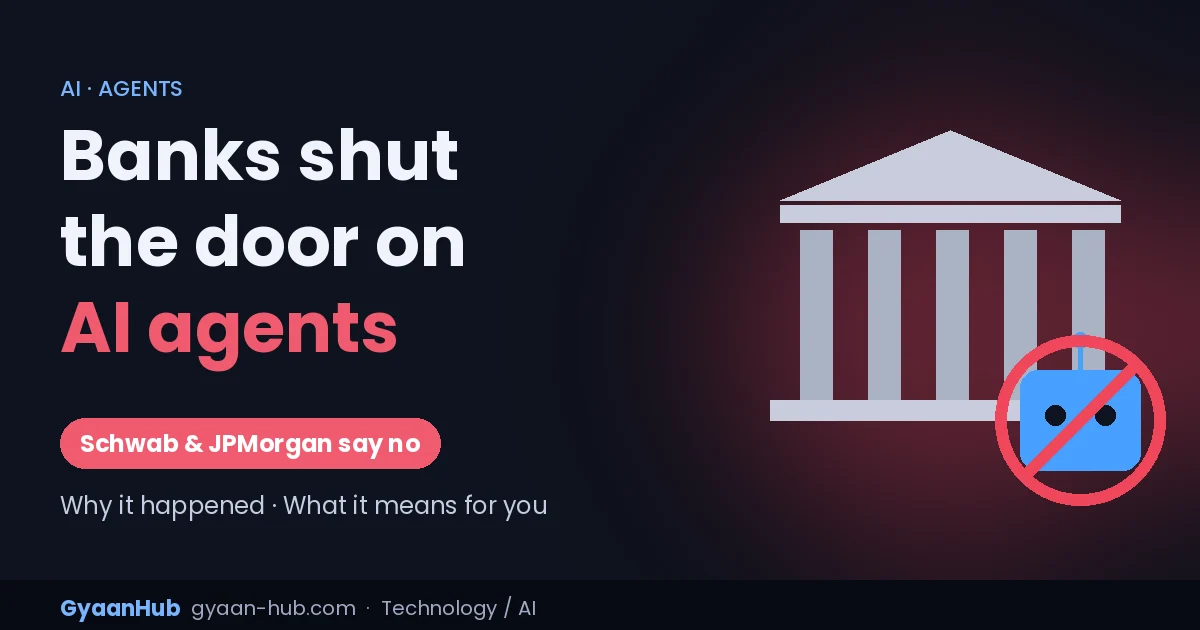
Quick answer: big US banks are shutting the door on outside AI agents. Charles Schwab says it blocks third-party agents, including Meta’s Muse, that try to move clients’ money, and JPMorgan Chase says outside agents won’t be allowed to act inside its systems. The reason is simple: when an AI agent moves money and something goes wrong, nobody yet knows who is responsible.
This is the first big real-world pushback against the “agentic web,” where AI assistants shop, book and pay on your behalf. Here is what happened and what it means.
What the banks said
Charles Schwab
- CEO Rick Wurster told Bloomberg Television on 16 October that Schwab blocks outside AI agents that try to move client money, naming Meta’s Muse agent among them.
- Schwab gets a weekly report of blocked attempts. Large agents are being stopped “in the tens and twenties each week”.
- His main concern is control and liability: if a client hands their password to an agent and it does something wrong, who pays?
JPMorgan Chase
- CEO Jamie Dimon said on the bank’s earnings call that outside AI agents won’t be allowed to act inside JPMorgan’s systems.
- JPMorgan already lets some third-party tools view account data, but not send money or pay bills.
Why banks are nervous
- Passwords: many agents work by logging in as the user. Sharing your banking password with any third party breaks the basic rules of account security.
- Liability: laws haven’t caught up. In the US, Congress is still debating who is responsible when an AI agent makes a costly mistake.
- Fraud and manipulation: an agent can be tricked by a malicious website or message into doing something its owner never asked for, known as prompt injection.
- Regulators are watching: US and European regulators are already questioning banks about AI agents and cyber risk.
The middle path: read, but don’t touch
The banks aren’t rejecting AI entirely. They want it on their terms:
- Schwab plans to offer Model Context Protocol (MCP) servers, a standard way for AI tools to connect to apps. Clients’ chosen AI models will be able to check balances and do research under Schwab’s rules, but not move money. Schwab also wants clients to use its own assistant, Charley.
- JPMorgan allows read-only access for some third-party tools.
Other sites are also restricting automated agents, and industry groups are working on standards like the Personal Agent Protocol to let agents prove who they are and what they are allowed to do.
What it means for you
- Never give an AI agent your banking password or OTP. If a tool asks for it, that’s a red flag.
- Use the AI features your bank provides, or tools that connect through official, read-only access.
- Expect the same debate in India. Indian banks follow strict RBI rules on authentication and OTPs, so fully autonomous AI payments are likely to arrive here only through official, bank-approved channels.
What it means for online stores
For e-commerce, this is a preview of the next few years. AI agents will increasingly browse, compare and add to cart, but the final payment step will likely stay under human or platform control until identity standards mature. Stores that offer clean product data and agent-friendly checkouts will be ready either way. We covered this shift in The Agentic Web: How AI Shopping Agents Are Changing E-commerce, and compared the latest models powering these agents in Gemini 4 vs GPT-6 vs Claude 5.5 vs Muse Wonder.
Frequently asked questions
Which banks are blocking AI agents?
Charles Schwab and JPMorgan Chase have both said they block outside AI agents from moving money or acting inside their systems.
Why are banks blocking AI agents?
Mainly because of security and liability: agents often need the user’s password, and there are no clear rules on who pays if an agent makes a mistake.
Can AI agents still access my bank account?
Some banks allow read-only access through approved connections, for example to check balances. Moving money through outside agents is being blocked.
Is it safe to give an AI assistant my bank password?
No. Never share your banking password or OTP with any third-party tool, AI or otherwise.
Sources: The Next Web; Bloomberg; The Verge; AI Weekly.