
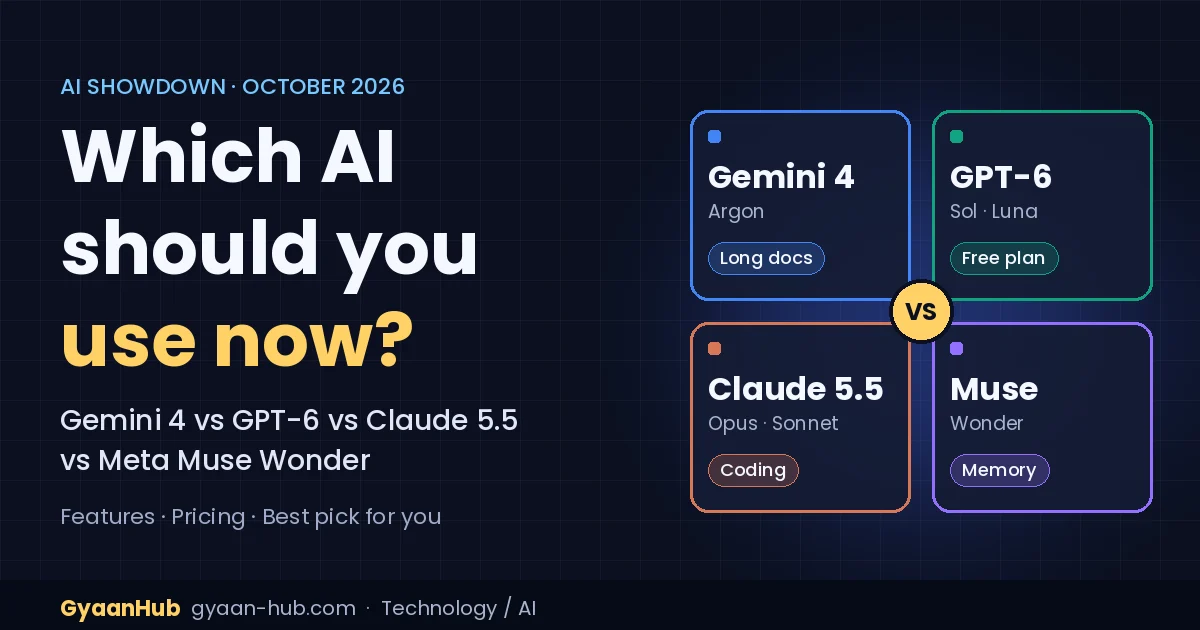
Quick answer: there is no single winner. In the space of three weeks, OpenAI, Google, Meta and Anthropic all shipped new flagship AI models. For free everyday use, ChatGPT’s GPT-6 Luna is the easiest pick. Gemini 4 Argon looks strongest for long documents and finance or legal research. Claude 5.5 leads on terminal-based coding and agent work. Meta’s Muse Wonder is the one to watch for memory, but most people can’t use it yet.
Here is what each model does, what it costs, and which one makes sense for you.
The October 2026 AI launch rush at a glance
| Model | Company | Released | Best known for |
|---|---|---|---|
| Claude Opus 5.5, Sonnet 5.5, Haiku 5.5 | Anthropic | 22 Sep, 28 Sep, 7 Oct | Coding, computer use, agent tasks |
| GPT-6 (Sol and Luna) | OpenAI | 7 Oct | Everyday chat, new “Intelligent UI” answers |
| Muse Wonder and Muse Wonder Full | Meta | 12 Oct | Long-term memory, persistent agents |
| Gemini 4 Argon | 13 Oct | Long context, finance and legal work, multimodal |
GPT-6 (ChatGPT): best for everyday users
OpenAI brought GPT-6 into ChatGPT on 7 October. Paying subscribers (Plus, Pro, Business, Enterprise) get GPT-6 Sol, while Free and Go users get GPT-6 Luna. Both versions are tuned for everyday conversation.
The headline feature is Intelligent UI. Instead of a wall of text, ChatGPT can now answer with charts, buttons, forms and small working tools. Ask for a trip budget and you get an editable calculator; ask about a concept and you can get an interactive diagram. OpenAI also says answers to web-search questions now start arriving 44% sooner than before.
Why it matters for India: the new model reaches free and low-cost ChatGPT Go users, so you do not need a premium plan to try it.
Gemini 4 Argon: best for long documents and research
Google launched Gemini 4 Argon on 13 October. It handles up to 1 million tokens of input and output combined through the API, enough for several large reports at once. In Google’s own tests, Argon led 13 of 19 benchmarks against Claude Opus 5.5 and OpenAI’s top model, with its biggest leads in finance tasks, legal tasks, automation and very long documents.
- Where to get it: the Gemini app and AI Mode in Search for Google AI Pro and Ultra subscribers, plus developers through the Gemini API and AI Studio.
- Weak spots: it trails Claude and OpenAI on some terminal-driven coding benchmarks.
- Developer pricing: an introductory $2 per million input tokens and $10 per million output tokens, rising to $4 and $20 after 30 November 2026.
Claude 5.5 family: best for coding and AI agents
Anthropic released three models over three weeks:
- Opus 5.5 (22 Sep): the most capable, aimed at agentic coding, computer use and long knowledge-work tasks. It scored 66.4% on Terminal-Bench 4.0 and 81.8% on OSWorld 2.1, a test of operating a computer like a person. API price: $4 / $20 per million tokens.
- Sonnet 5.5 (28 Sep): faster and cheaper, close to Opus on many tests, and strong at documents, slides and spreadsheets. API price: $2 / $10.
- Haiku 5.5 (7 Oct): the budget model, with a 1 million token context window and prices from $0.10 per million input tokens. Ideal for high-volume jobs like summarising or sorting data.
Claude has a free plan with limited usage; heavier use and the top models need a paid plan.
Meta Muse Wonder: best memory, limited access
Meta’s first frontier models arrived on 12 October. Their standout feature is Active Memory, which carries details across conversations, and Meta’s tables show Muse Wonder topping the MemoryBench test. Meta also highlights “Active Focus”, which keeps the model working towards a goal and checks in before important actions.
The catch is access. Muse Wonder is available to developers through the Meta Model API at $4 / $20 per million tokens, while the stronger Muse Wonder Full is only on Muse Code subscriptions. Meta says it will reach its Muse app soon, starting with subscribers, and early reports say the plans launched in North America only. Indian users will likely have to wait.
Head-to-head: which AI should you use?
| If you want to… | Pick | Why |
|---|---|---|
| Use AI free for daily questions | ChatGPT (GPT-6 Luna) | Newest model on the free plan, interactive answers |
| Analyse long PDFs, reports or videos | Gemini 4 Argon | 1M-token context, leads long-context tests |
| Write or fix code, run agents | Claude Opus or Sonnet 5.5 | Leads terminal and computer-use benchmarks |
| Process data cheaply at scale | Claude Haiku 5.5 or Gemini (intro pricing) | Lowest per-token cost |
| An assistant that remembers you | Muse Wonder (when available) | Built around long-term memory |
Developer pricing compared
| Model | Input ($ per 1M tokens) | Output ($ per 1M tokens) |
|---|---|---|
| Gemini 4 Argon | 2 (4 after 30 Nov) | 10 (20 after 30 Nov) |
| Claude Opus 5.5 | 4 | 20 |
| Claude Sonnet 5.5 | 2 | 10 |
| Claude Haiku 5.5 | 0.10 | 0.50 |
| Meta Muse Wonder | 4 | 20 |
OpenAI has not published separate API pricing for the GPT-6 models used in ChatGPT.
A word of caution on benchmarks
Almost every score above comes from the companies’ own testing, and each company picks the tests where it looks best. Independent results usually arrive a few weeks after launch. The practical test is simple: try the same task on two or three of these tools and keep the one that gives you the best answer for your work.
What this means for you
AI is shifting from chatbots that answer questions to agents that finish tasks: filling forms, writing and testing code, shopping on your behalf. We covered how that is changing online shopping in The Agentic Web: How AI Shopping Agents Are Changing E-commerce. The models launched this month are the engines behind that shift.
Frequently asked questions
Which is the best AI model in October 2026?
It depends on the job. Gemini 4 Argon leads many of Google’s published benchmarks, Claude Opus 5.5 leads terminal coding and computer-use tests, and GPT-6 brings the newest model to ChatGPT’s free plan.
Is GPT-6 free in ChatGPT?
Yes. Free and Go users get GPT-6 Luna, while paid plans get GPT-6 Sol.
Can I use Gemini 4 Argon for free?
In the Gemini app it is available to Google AI Pro and Ultra subscribers. Developers can use it through the Gemini API at introductory pricing.
Is Meta Muse Wonder available in India?
Not widely yet. It is on Meta’s developer API, and Muse Code plans were reported to be North America only at launch.
Which AI is best for coding?
Claude Opus 5.5 and Sonnet 5.5 lead on terminal-based coding benchmarks, while Gemini 4 Argon leads some software-engineering tests in Google’s results. Try both on your own codebase.
Sources: Google, OpenAI, Anthropic and Meta announcements; TechCrunch; DataCamp; eesel AI; 9to5Mac. Benchmark figures are as reported by the companies.